
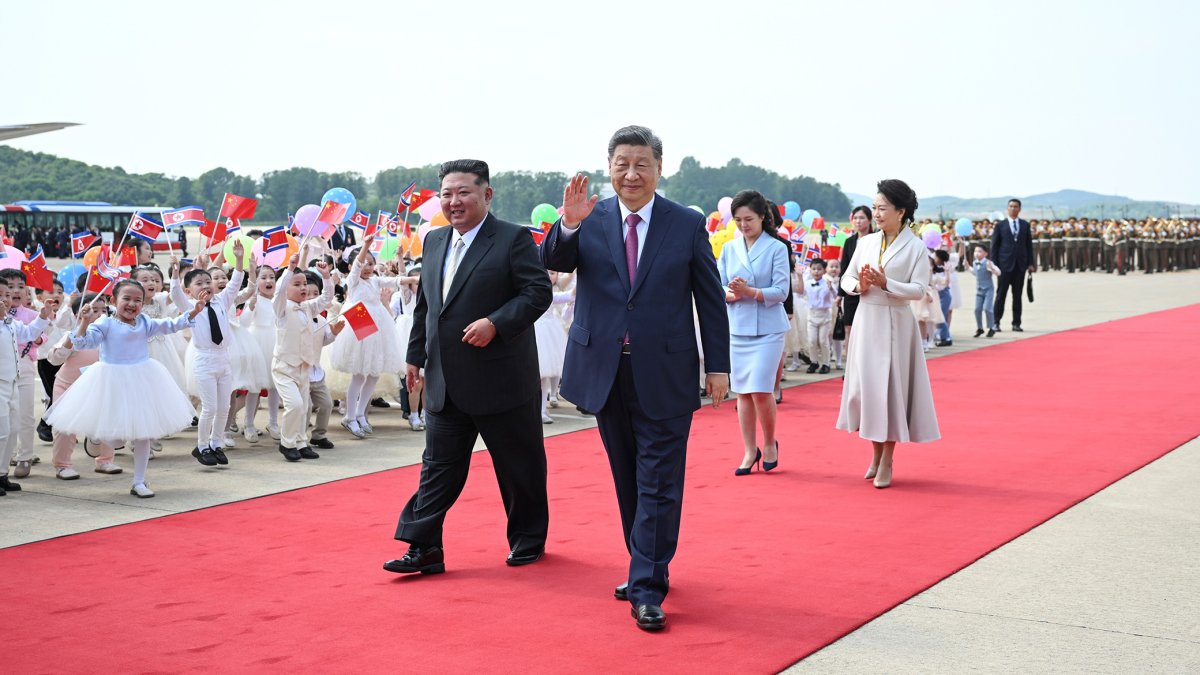
In June 2026, Chinese leader Xi Jinping traveled to Pyongyang for a high-level summit with Kim Jong-un. Marking his first trip abroad of the year and his first visit to North Korea in seven years. Timed around the 65th anniversary of the bilateral Treaty of Friendship, Cooperation, and Mutual Assistance. This meeting signaled a major effort to reset and deepen ties between the two nations. The leaders agreed to expand strategic alignment across a wide range of domains, including trade, infrastructure, culture, science, and law enforcement. Notably, for the first time in a public summit readout, military affairs were explicitly included as an area for deeper bilateral development.
A major strategic driver behind this diplomatic push is Beijing’s desire to reassert its influence over Pyongyang. In addition, counter the growing bond between North Korea and Russia following the war in Ukraine. In recent years, high-level exchanges between Moscow and Pyongyang had significantly outnumbered those between Beijing and Pyongyang, making Chinese leadership uneasy about losing leverage over its neighbor. Additionally, Beijing’s recalibration reflects efforts to hedge against regional uncertainties involving the United States, balance Japan’s military buildup, and strengthen its geopolitical positioning regarding Taiwan.
A particularly critical shift in Beijing’s official stance is the total absence of any reference to the denuclearization of the Korean Peninsula in summit statements. Historically a mandatory component of Chinese diplomatic communications regarding North Korea. In short, this deliberate omission suggests Beijing’s tacit, de facto acceptance of North Korea as a nuclear-armed state in exchange for strategic alignment.
In conclusion, the reset in China-North Korea relations marks a pivotal realignment in East Asian geopolitical dynamics. Driven by a mutual need to navigate shifting global power structures, China is prioritizing strategic buffer and regional leverage over nonproliferation goals. By strengthening economic, political, and military cooperation while quietly accepting North Korea’s nuclear status- Ultimately, Beijing is securing a firm foothold on the Korean Peninsula to counter Western influence and balance Russian power in the region.
Reference
Cha, V., Lin, B., Tinsley, T., & Lim, A. (2026, August 6). Old Friends, New Calculations: A Reset in China-North Korea Relations. CSIS; Center for Strategic and International Studies. https://www.csis.org/analysis/old-friends-new-calculations-reset-china-north-korea-relations