
As the United States and China intensify their competition for global AI leadership, many countries fear becoming technologically dependent on the two superpowers. This concern has inspired the concept of “sovereign AI”. The pursuit of domestic AI infrastructure, talent, and regulatory control that allows a nation to independently build, deploy, and manage advanced AI systems
South Korea has positioned itself as one of the strongest contenders outside the U.S.–China axis capable of achieving meaningful AI autonomy. President Lee Jae Myung has framed the stakes dramatically, describing the AI race as a “life-or-death crisis” where even a one-day delay could mean losing a generation’s advantage. His administration has pushed aggressively to expand AI funding, proposing a tripling of next year’s budget to nearly $6.8 billion.

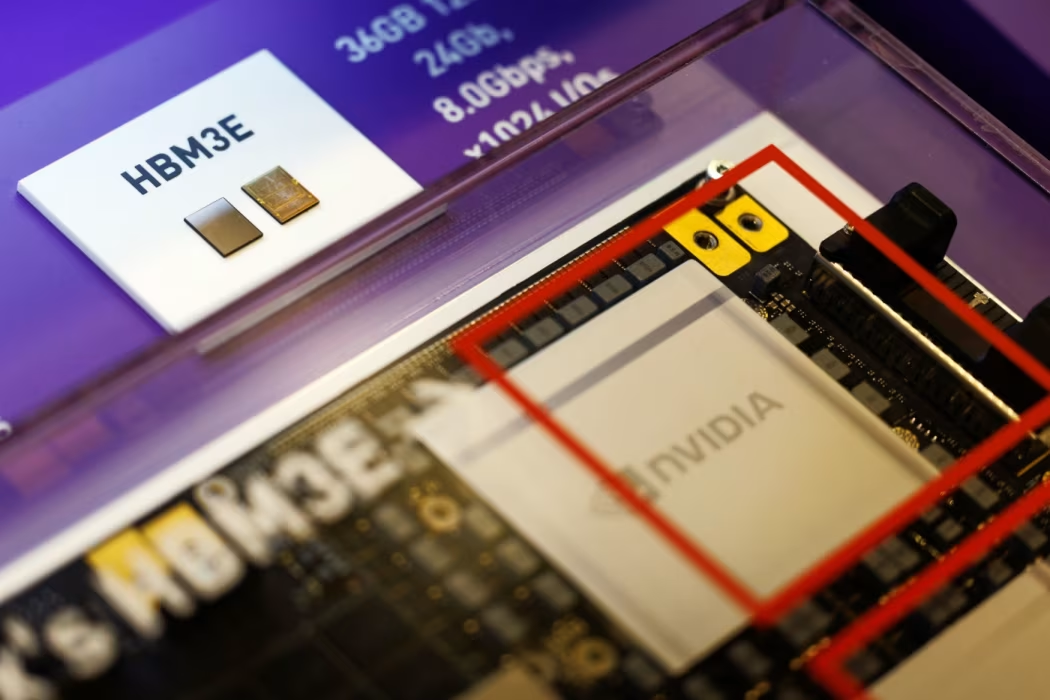
The country’s attempt at sovereign AI is supported by long-standing strengths. Advanced semiconductor manufacturing from Samsung and SK Hynix, a deep pool of software expertise, and substantial financial resources. A newly created “National Growth Fund” worth about $102 billion aims to fuel high-tech strategic industries, including AI, over the next five years. The government has also secured a major deal to obtain 260,000 Nvidia GPUs. Resources intended to power both public and private data centers as well as a national large language model.
South Korean conglomerates, including Samsung, Hyundai, SK, and LG, are investing heavily in AI for manufacturing, chip design, and large-scale computing infrastructure. Smaller domestic chip startups such as Rebellions and FuriosaAI are also emerging as potential challengers to Nvidia in specialized AI hardware, highlighting South Korea’s expanding innovation ecosystem.

Effect Worldwide
Globally, sovereign AI has gained support from governments and industry leaders. Nvidia CEO Jensen Huang promotes the idea as essential for countries seeking control over their cultural and economic futures. Nations such as France, Germany, the U.K., India, Saudi Arabia, and the UAE are pursuing their own sovereign AI strategies, with spending on AI infrastructure expected to surpass $1.5 trillion this year.
However, the road ahead is challenging. Countries must overcome limits in energy supply for data centers and navigate the influence of U.S. export controls that shape access to advanced chips and technologies. Analysts note that South Korea’s success or failure could serve as a model or warning, for other nations seeking AI independence.
As South Korea scales up its computing power, expands semiconductor leadership, and nurtures domestic AI developers, it is rapidly becoming a pivotal test case for whether sovereign AI is achievable outside the U.S.-China duopoly.
Reference
Sohn, J. (2025, November 25). ‘Sovereign AI’ takes off as countries seek to avoid overreliance on superpowers. The Wall Street Journal. https://www.wsj.com/tech/ai/sovereign-ai-takes-off-as-countries-seek-to-avoid-overdependence-on-superpowers-6b1689f7?st=KNUYp4