
European officials warn that Donald Trump’s push to take control of Greenland risks splitting Nato and handing strategic advantages to China and Russia. EU foreign affairs chief Kaja Kallas argues that Beijing and Moscow benefit from the turmoil Trump creates. Even when Trump claims he wants to prevent China and Russia from gaining influence in the Arctic. From Beijing’s perspective, Trump’s threats reinforce the view that the US-led order is fracturing, weakening the alliance system that China has long seen as Washington’s main source of global power.
Chinese analysts describe Trump’s Greenland rhetoric as bullying and hegemonic, but they also note that a US move against Denmark would signal Nato’s decline. That outcome would please many in China, since Beijing views the unraveling of US alliances as strategically advantageous. Experts stress that Chinese planners never considered a US annexation of Greenland a realistic scenario. Instead, they worried far more about the cohesion of American alliances. Trump’s actions now appear to undermine those alliances from within.
US concerns about China’s Arctic ambitions predate Trump. American officials have warned for years about Beijing’s growing presence in the region. Yet China has struggled to gain a foothold in Greenland, largely because Denmark and the US have blocked Chinese investment in infrastructure and strategic assets. These obstacles have limited Beijing’s influence far more effectively than any dramatic show of force.
China officially frames its position as support for state sovereignty and the UN charter. Besides, it criticizes Washington for invoking a “China threat” to justify tariffs and pressure on European allies. At the same time, Beijing watches closely as Trump’s approach strains transatlantic relations and introduces uncertainty into Arctic governance.
Hopes of a ‘Polar Silk Road’
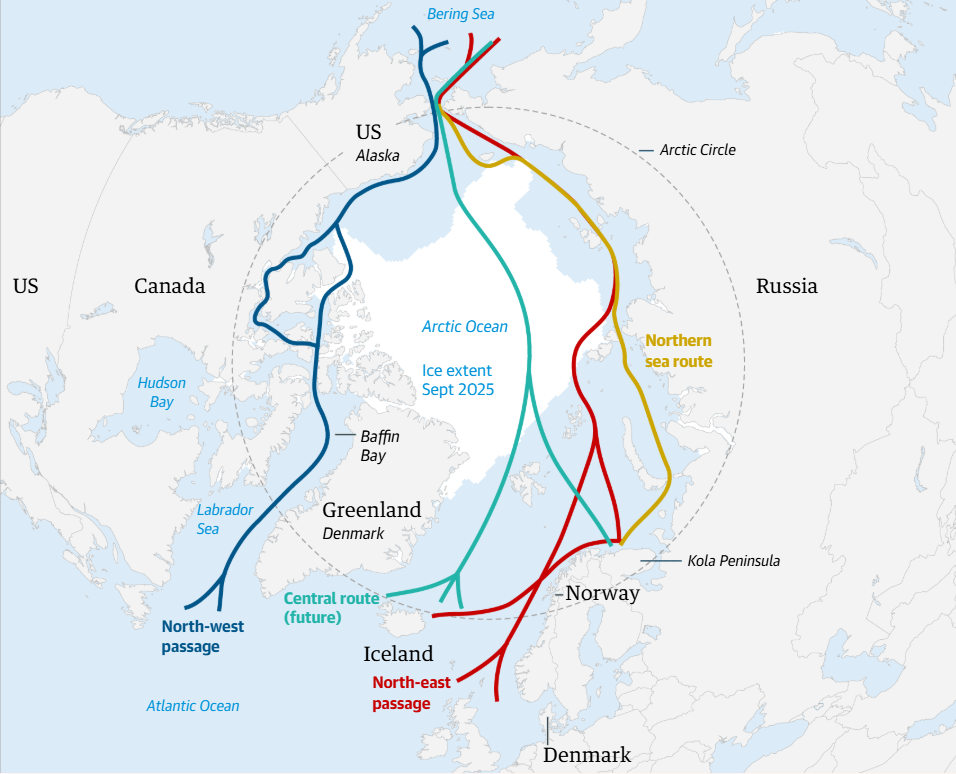
China has pursued Arctic interests through investment and long-term planning rather than territorial ambition. Between 2012 and 2017, Chinese investment formed a significant share of Greenland’s economy, driven by interest in minerals and shipping routes. Beijing outlined these ambitions in its 2018 Arctic white paper, where it labeled China a “near-Arctic state” . It promoted the idea of a “Polar Silk Road” as part of the Belt and Road Initiative.
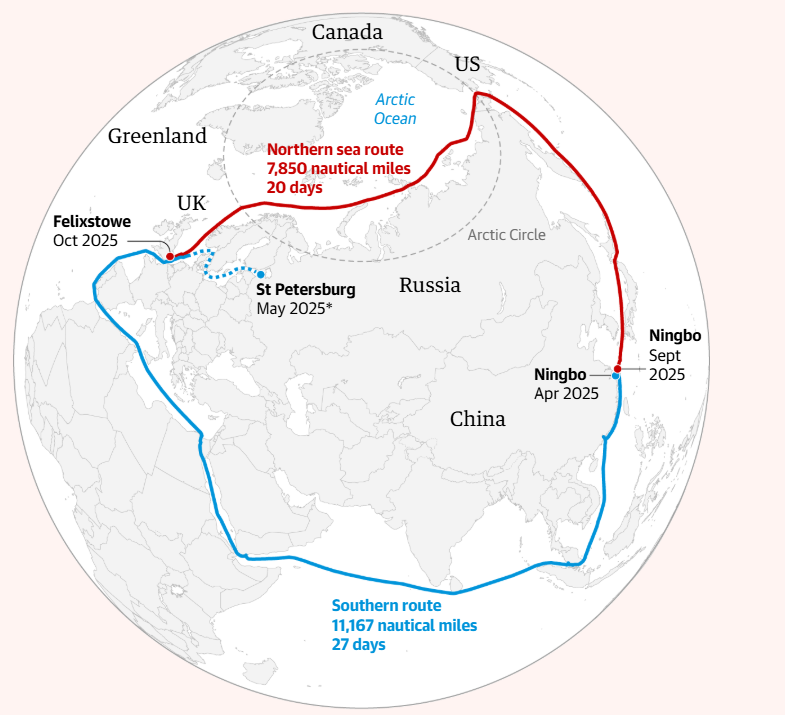
Guardian graphic. Source: Tracking data: MarineTraffic. Journey calculations: Centre for High North Logistics
That vision took a symbolic step forward when a Chinese container ship traveled from China to Europe via the Northern Sea Route along Russia’s Arctic coast, cutting travel time roughly in half. This route, however, depends heavily on cooperation with Russia, a partnership that has drawn increased scrutiny from Europe since the war in Ukraine. Meanwhile, Chinese mining ambitions in Greenland have stalled, facing political resistance, regulatory barriers, and bans on uranium mining that froze key projects.
Experts now describe China’s current presence in Greenland as minimal. US and Danish opposition, combined with Western efforts to diversify rare earth supply chains away from China. Situation that left Beijing with few realistic options to expand its role there. Trump’s overt interest in Greenland has only hardened these barriers.
China now faces a strategic dilemma: Trump weakens the global alliances that constrain Beijing’s rise, but his volatility and strongman instincts also create new risks. As Washington disrupts the very order it once led, Beijing watches carefully. Now weighing the benefits of a fractured alliance system against the dangers of an unpredictable United States.
Reference
Hawkins, A. (2026, 21 enero). China sees an opportunity in Greenland, but not in the way that Trump thinks. The Guardian. https://www.theguardian.com/world/2026/jan/21/china-strategic-opportunity-greenland-us-donald-trump?CMP=Share_AndroidApp_Other