
Assessing Exposure to Artificial Intelligence and Adaptive Capacity
Measures of artificial intelligence exposure typically estimate how much workplace tasks could be performed or augmented by AI technologies across occupations. These estimates capture technical susceptibility but do not show how workers might respond if displacement actually occurs. A broader approach combines exposure with adaptive capacity, defined as the resources and conditions that help workers transition to new employment.
Adaptive capacity reflects savings, age, education, transferable skills, employment history, and the strength of local markets. Workers with greater financial buffers and versatile skills are more likely to absorb temporary income loss and search for new opportunities. Younger workers also tend to adjust more easily due to longer time horizons and higher mobility. Strong regional labor markets further increase the likelihood of reemployment following job disruption.
When exposure and adaptive capacity are evaluated together, the results challenge the assumption that high exposure automatically implies high vulnerability. Many jobs with significant AI exposure are held by workers with strong education levels, higher wages and broader professional networks. These traits reduce the probability of long-term unemployment even if job tasks change significantly.
Among approximately 37.1 million U.S. workers in occupations most exposed to AI, roughly 26.5 million demonstrate above-median capacity to adapt. These workers are concentrated in professional, technical, and managerial roles where AI may reshape tasks rather than eliminate positions. Occupational groups such as software developers, engineers and financial professionals illustrate how exposure can coexist with resilience. Their skills are often portable across firms and industries, allowing smoother transitions during technological change. This combined framework emphasizes that exposure alone overstates displacement risk for large segments of the workforce.
Groups Facing Higher Risk and Implications for Policy
Despite overall resilience among many exposed workers, a smaller but significant group faces both high exposure and low adaptive capacity. Around 6.1 million workers fall into this category, combining task susceptibility with limited resources for adjustment. These workers tend to be older, have lower savings, and possess narrower skill sets tied to specific job functions. Many are employed in clerical and administrative support roles, when routine tasks are more easily automated. Limited access to retraining and weaker professional networks further reduce their adjustment prospects.
Gender patterns are especially pronounced within this vulnerable group, as approximately 86% are women. This reflects occupational segregation and long-standing disparities in wages, job stability, and access to advancement opportunities. Geographic factors also shape vulnerability, with higher concentrations in smaller metropolitan areas and college towns. Regions in the Mountain West and parts of the Midwest show elevated shares of workers facing both high exposure and low adaptability. These areas often have fewer alternative employers and slower job creation, which complicates reemployment after displacement.
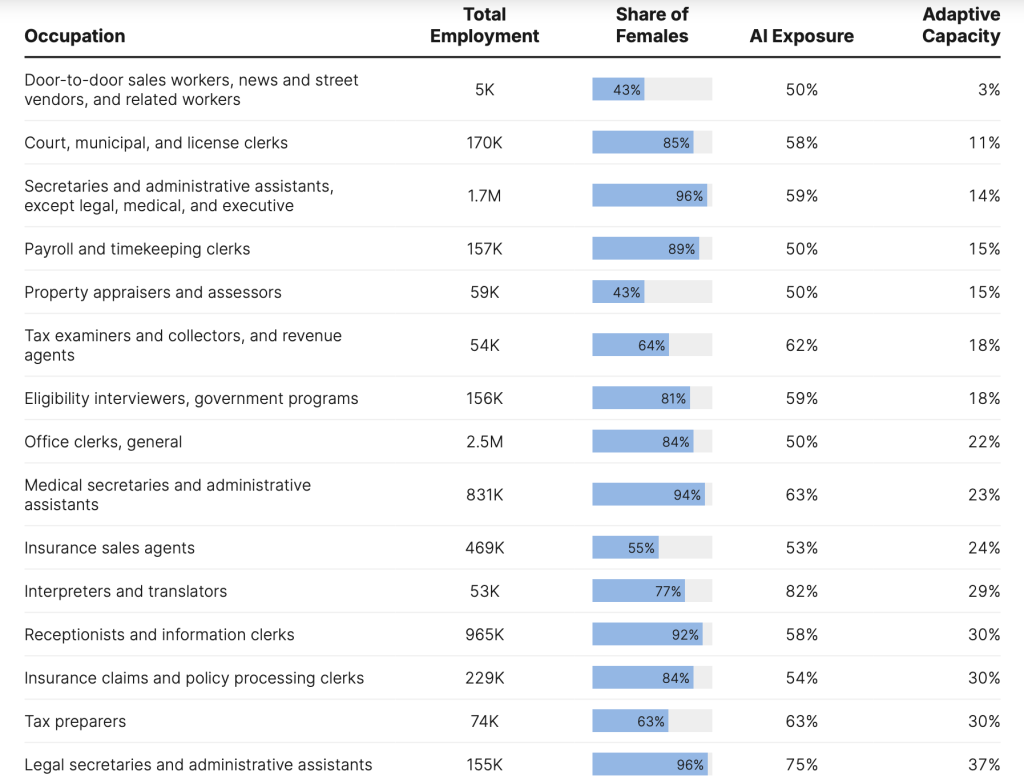
Note: Shows 15 occupations with the lowest adaptive capacity among those in the top quartile of AI exposure. Adaptive Capacity is a composite index of occupation-level characteristics that shapes how costly it is if a worker in a given occupation gets displaced. AI exposure shows the percentage of tasks exposed to LLMs (Eloundou et al., 2024).
Occupational demographic shares are calculated using Lightcast data, which is based on QCEW employment. Since the original employment counts in the paper rely on OEWS, total employment levels differ slightly.
Evaluating adaptive capacity alongside exposure helps identify where economic disruptions could have the greatest social costs. It also shifts attention toward preventive strategies rather than reactive responses. Policies that support reskilling, income smoothing, and regional development can reduce adjustment burdens before displacement occurs. Targeted interventions are especially relevant for workers with limited financial buffers and restricted mobility. By focusing on worker characteristics and local conditions, this framework provides a clearer picture of how AI-driven change may reshape labor markets unevenly. It offers guidance for directing workforce support to those least equipped to manage transitions, rather than assuming uniform risk across exposed occupation.
Source:
Manning, S., Aguirre, T., Muro, M., & Methkupally, S. (2026, January 21). Measuring US workers’ capacity to adapt to AI-driven job displacement. Brookings Institution. https://www.brookings.edu/articles/measuring-us-workers-capacity-to-adapt-to-ai-driven-job-displacement/