
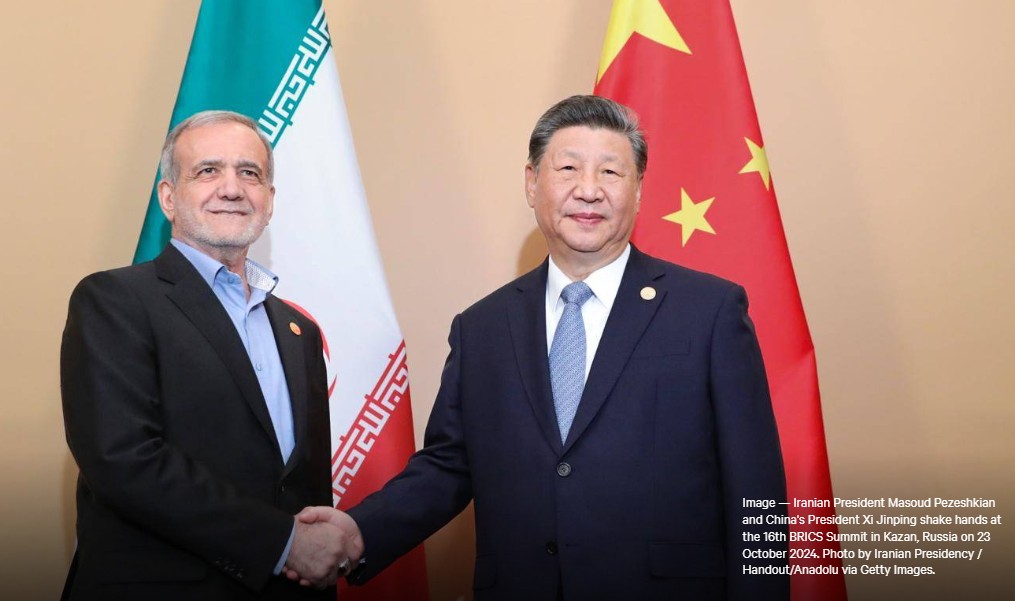
Beijing’s Long Game in the US–Iran Standoff
The article China is playing the long game over Iran analyzes what appears to be diplomatic restraint but is, in fact, a calculated China Iran strategy. Despite close economic and political ties with Tehran, Beijing has avoided overt military support amid renewed US pressure and military build-up in the Gulf.
Rather than signaling unreliability, China’s cautious approach reflects long-term geopolitical calculation. Beijing prioritizes strategic patience, regional stability, and the gradual erosion of US influence over immediate confrontation.
Strategic Restraint, Not Abandonment
At first glance, China’s limited response to US threats against Iran seems inconsistent with its 25-year strategic partnership agreement with Tehran. China remains Iran’s main oil buyer, purchasing over 80% of its shipped oil in 2025, and has supported Iran’s integration into BRICS+ and the Shanghai Cooperation Organisation.
However, Beijing has consistently avoided military backing. Even during the 12-day war in 2025, China condemned strikes but offered no material support. This pattern demonstrates continuity, not hesitation. The China Iran strategy seeks leverage without escalation.
The Nuclear Issue and Regional Stability
China publicly opposes Iranian nuclear weaponization while supporting Iran’s right to peaceful nuclear energy under the Non-Proliferation Treaty. Beijing’s priority is preventing a regional war that could disrupt Gulf shipping lanes and threaten Chinese energy imports.
A nuclear-armed Iran could trigger arms races across the Middle East and beyond, potentially encouraging nuclear ambitions among US allies in Asia. For this reason, diplomatic resolution aligns with China’s interests. Limited US-Israeli strikes that lead to negotiations may even be tolerated if they avoid full-scale war and preserve regional balance.
Thus, the China Iran strategy is less about ideological alignment and more about risk management.
A Weakened Iran as Strategic Opportunity
China does not seek regime collapse in Tehran, which could produce a Western-aligned government. At the same time, a weakened Iran increases Beijing’s leverage. Economic vulnerability deepens Tehran’s dependence on Chinese markets, technology and investment.
Reports of advanced Chinese weapons transfers remain unconfirmed, suggesting Beijing calibrates involvement carefully. The goal is influence without direct entanglement. Dependence strengthens China’s long-term position while keeping diplomatic flexibility intact.
Undermining US Hegemony Indirectly
The article argues that cyclical US-Iran tensions serve Beijing’s broader objectives. Limited escalations impose financial and military costs on Washington, diverting attention from the Indo-Pacific.
China does not aim to replace US dominance in the Middle East outright. Instead, it seeks gradual erosion of American hegemony. By maintaining strategic ambiguity, Beijing can pursue concessions on trade and Taiwan while avoiding direct confrontation.
In this sense, the China Iran strategy is incremental, indirect and patient.
Reference
Aboudouh, A. (2026, February 27). China is playing the long game over Iran. Chatham House. https://www.chathamhouse.org/