
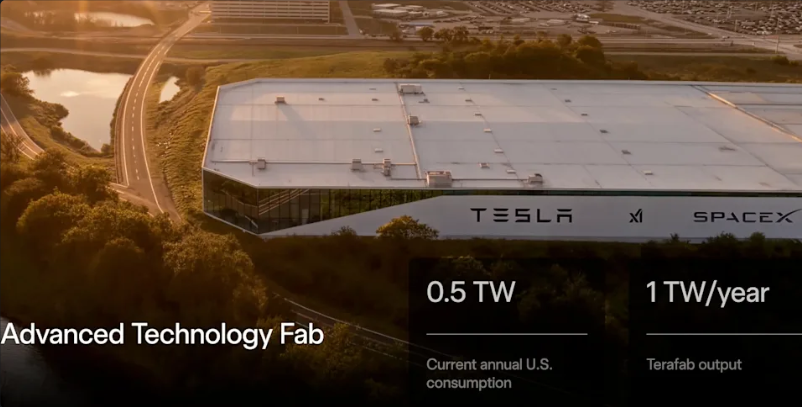
Terafab emerges as a massive semiconductor initiative in Austin, Texas, created by Tesla, SpaceX, and xAI to centralize chip design, fabrication, memory, and packaging in a single complex that will surpass Giga Texas in size. Conceived to address severe bottlenecks in external supply from foundries like TSMC and Samsung, the project responds to Elon Musk’s claim that existing manufacturers cannot expand at the pace required to meet the AI and robotics computing needs of his companies. Musk describes Terafab as “the most epic chip-building exercise in history by far,” underscoring its ambition to produce chips using a cutting‑edge 2‑nanometer process at a scale far beyond current internal demand. Initial investment is estimated at 20 to 25 billion dollars, although external analysts project that building significant capacity could ultimately require around 35 to 45 billion, with Tesla’s 2026 capital expenditures not yet incorporating these costs.
Terafab focuses on two main chip families: an edge‑inference processor for Tesla’s Full Self‑Driving systems, the Optimus humanoid robot, and Robotaxi fleets, and a radiation‑hardened high‑power variant meant for satellites, orbital data centers, and xAI workloads in space. The Optimus program constitutes the strongest source of demand because forecasts for Giga Texas point to potential output of 10 million robots per year, implying the need for 20 million chips, several times Tesla’s current automotive chip usage. If long‑term targets of 100 million robots annually were achieved, chip demand would exceed 200 million units, more than 50 times today’s combined requirements for vehicles and Robotaxis. Musk’s stated objective is to surpass one terawatt of AI computing power per year, directing most of that capacity to space‑based infrastructure while starting the project with prototyping and testing phases and without firm operational timelines.
Despite the technological ambition, the undertaking is described as a “Herculean task,” given that 2‑nanometer processes rest on decades of incremental advances and Musk lacks direct semiconductor manufacturing experience, in addition to his reputation for overly optimistic schedules. Even so, analysts like Morgan Stanley’s Andrew Percoco consider internal chip capacity strategically sound as access to AI compute becomes a binding constraint and Terafab is configured to serve Musk’s ecosystem rather than external customers.
Reference
Subramanian, P. (2026, March 24). Elon Musk’s Terafab is here: What it is, and why it’s important for Tesla and SpaceX. Yahoo Finance. https://finance.yahoo.com/news/elon-musks-terafab-is-here-what-it-is-and-why-its-important-for-tesla-and-spacex-163426221.html