
The Transition from Communal Strife to a Moral Mandate for Peace
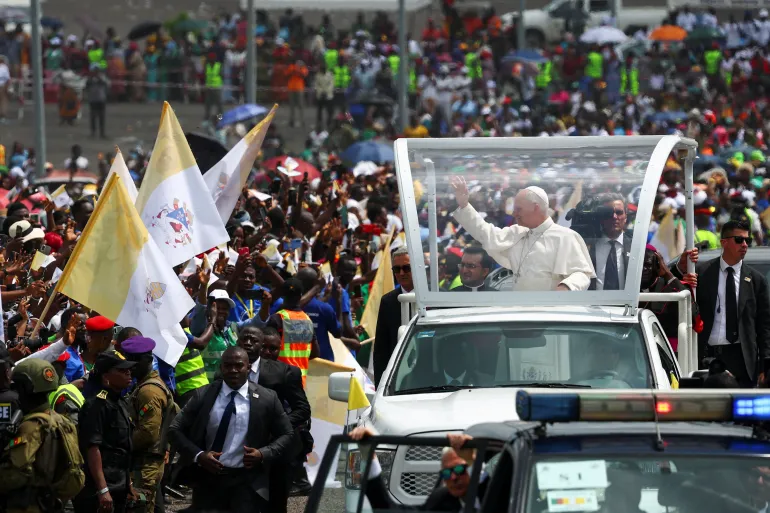
By mid-April 2026, the long-standing crisis in Cameroon’s Anglophone regions has transitioned from a localized secessionist movement into a pervasive humanitarian emergency. During a historic visit to the capital, Pope Leo addressed a massive gathering of 120,000 people, calling for a definitive rejection of violence and a return to national dialogue. Consequently, the focus of the conflict has moved from purely military maneuvers to a struggle for moral authority, as the Catholic Church attempts to position itself as a neutral mediator between the central government and separatist factions. This suggests that after nearly a decade of fighting, there is an increasing recognition that a military solution is unattainable, shifting the burden of resolution toward civil society and spiritual leadership.
Origins and the Escalation of the “Anglophone Crisis”
Originally, the conflict began in 2016 as a series of peaceful protests by teachers and lawyers against the perceived marginalization of the English-speaking minority by the Francophone-dominated government. However, the origin of the current high-stakes confrontation lies in the 2017 symbolic declaration of independence by Ambazonia, which triggered a brutal state crackdown and the radicalization of various armed groups. For 2026, the report emphasizes that the crisis has reached a tipping point, with over 6,000 dead and hundreds of thousands displaced. The Pope’s visit represents the highest level of international intervention to date, aimed at breaking the cycle of retaliatory attacks that have paralyzed the country’s northwest and southwest regions for years.
The Structure of the “Dialogue Deadlock”
The structure of the Cameroonian impasse is organized around three layers of deep-seated political and cultural friction. First is the institutional barrier; the central government in Yaoundé has historically rejected any discussion of federalism or autonomy, viewing such proposals as a threat to national unity. Second is the fragmentation of the separatist movement, as the report notes that several “self-defense” militias operate independently, making it difficult for the Church or other mediators to identify a single representative body for negotiations. Finally, the article highlights the humanitarian friction, where the use of “ghost towns” (forced lockdowns) and school boycotts as political tools has effectively deprived an entire generation of children of their education and basic social services.
Synthesis of the Moral Authority and the Security Dilemma
The successful de-escalation of the violence now faces a paradox where the “moral appeal” of the Papacy may lack the structural enforcement necessary to change behavior on the battlefield. This represents the security dilemma in political science, where neither the state nor the insurgents are willing to be the first to disarm without ironclad guarantees of safety and political representation. There is a clear intent in the Al Jazeera report to portray the Papal Mass as a “last-ditch” effort to prevent the country from sliding into total civil war. Ultimately, it is clear that for 2026, Cameroon serves as a case study for the limits of international mediation in post-colonial conflicts where linguistic and administrative identities have become deeply entrenched.
Reference
Al Jazeera. (2026, April 17). Pope Leo calls on Cameroonians to reject violence as 120,000 join mass. Al Jazeera News Africa. https://www.aljazeera.com/news/2026/4/17/pope-leo-calls-on-cameroonians-to-reject-violence-as-120000-join-mass