
The Transition from Middle-Power Diplomacy to Hard Power Realism
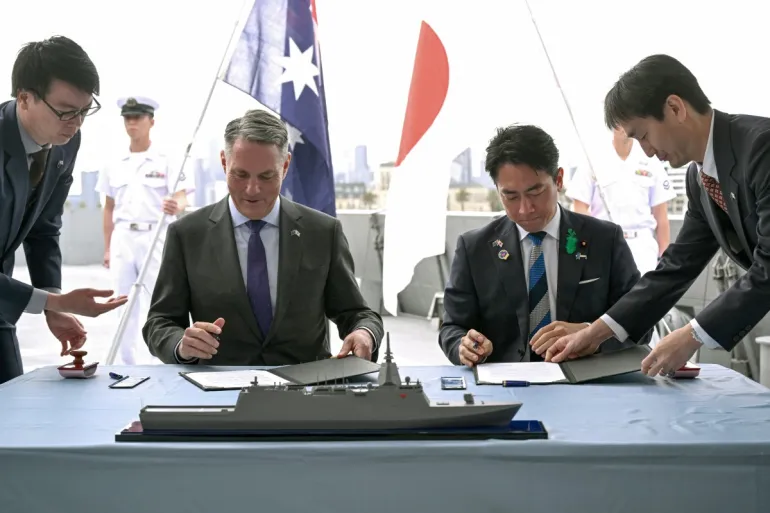
By mid-April 2026, the security partnership between Australia and Japan has transitioned from symbolic joint exercises to a massive integration of industrial and military capabilities. The Al Jazeera report highlights the formal signing of a $7 billion contract for the construction of next-generation warships, signaling a significant shift in the Indo-Pacific’s strategic architecture. Consequently, the focus in the region has moved from reliance on traditional U.S. security guarantees to a “Minilateral” approach, where key regional powers are building independent, interoperable naval strength. This suggests that Canberra and Tokyo are no longer waiting for a global resolution to the current Middle East crisis but are instead preparing for a sustained period of maritime instability closer to home.
Origins and the “Indo-Pacific Pivot” of 2026
Originally, Australian and Japanese defense procurement was largely siloed, with both nations looking toward Washington for major surface combatants. However, the origin of this $7 billion deal lies in the strategic shock of the 2026 naval blockades, which exposed the vulnerability of global energy supply chains and the limits of U.S. naval overextension. For 2026, this contract represents the “Japan-Australia Reciprocal Access Agreement” in action, moving beyond legal frameworks into the physical co-production of military hardware. Furthermore, the report emphasizes that this deal is a direct response to the “Power Vacuum” perceived in the Pacific as American assets remain tied down in the Persian Gulf and Eastern Europe, forcing regional allies to accelerate their own sovereign defense timelines.
The Structure of the “Minilateral” Security Model
The structure of this $7 billion naval deal is organized around three layers of geopolitical and industrial friction. First is the “Interoperability” mandate; the new vessels are designed to function as a seamless fleet, allowing Australian and Japanese crews to operate across shared platforms during crises. Second is the industrial friction, as the report notes the domestic political pressure in both nations to ensure that the $7 billion investment translates into local jobs and technological transfers, rather than just off-the-shelf purchases. Finally, the article highlights the diplomatic friction with China, as Beijing views this deepening “Quasi-Alliance” as a provocative step toward a regional “Asian NATO” designed to contain its maritime ambitions.
Synthesis of Strategic Autonomy and the Arms Race Paradox
The successful signing of these contracts now faces a paradox where the pursuit of “Regional Balance” may inadvertently trigger a localized arms race. This represents the security dilemma in political science, where defensive measures taken by middle powers are interpreted as offensive threats by regional rivals, leading to an escalatory cycle. There is a clear intent in the Al Jazeera analysis to show that Australia and Japan are prioritizing “Strategic Autonomy” as a hedge against an increasingly unpredictable global order. Ultimately, it is clear that for 2026, this warship deal is the cornerstone of a new “Secondary Security Tier” in the Pacific, proving that the era of total reliance on a single superpower has come to an end.
Reference:
Al Jazeera. (2026, April 19). Australia and Japan sign contracts for $7bn warships deal. Al Jazeera Economy. https://www.aljazeera.com/economy/2026/4/19/australia-and-japan-sign-contracts-for-7bn-warships-deal