
A Sudden Shift in Continental Defense Priorities
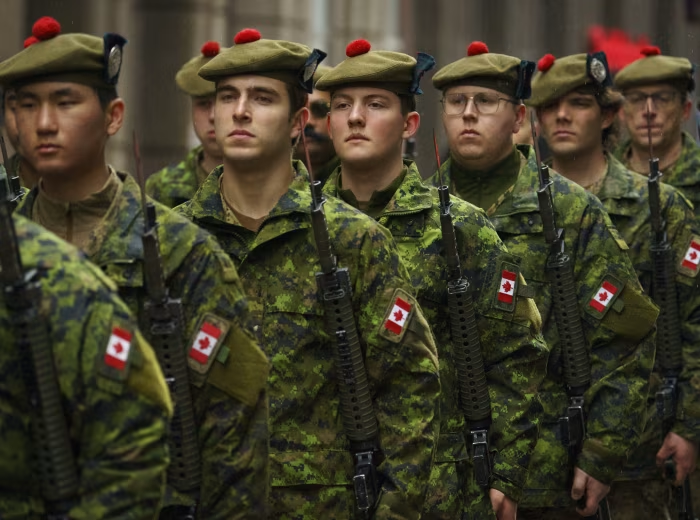
The historic security alliance between the closest neighbors in North America is navigating a period of profound structural strain. According to an extensive geopolitical analysis by The Wall Street Journal, Canada is launching an urgent, massive expansion of its national defense capabilities. Historically, Ottawa has relied heavily on the protective military umbrella provided by the United States. However, aggressive political shifts and unilateral policy demands from the White House are forcing a rapid recalculation of this traditional security dependence. Consequently, Canadian policymakers are rushing to modernize their armed forces to protect sovereign assets independently.
Aggressive Washington Pressure Over Minimal NATO Contributions
The primary catalyst for the diplomatic friction centers on long-standing disputes regarding international defense spending benchmarks. Specifically, the current U.S. administration has intensified its public condemnation of Ottawa for consistently failing to meet the mandatory NATO spending target of two percent of gross domestic product. For instance, Washington officials have dropped sharp hints that future trade protections and border cooperation could be directly linked to defense compliance. Therefore, Canadian Prime Minister Justin Trudeau is moving quickly to approve massive new defense outlays. This legislative shift aims to appease American critics and avoid economically devastating commercial retaliation.
Securing Strategic Sovereignty Across a Vulnerable Arctic Frontier
The most critical geographic driver behind Canada’s defense modernization push involves the rapidly melting Arctic maritime corridors. As polar ice caps recede, international shipping routes and vast untapped natural resource deposits are becoming increasingly accessible. For example, competing global superpowers, including Russia and China, are aggressively expanding their naval presence and strategic capabilities throughout the northern polar circle. Because Canada’s current northern surveillance networks and icebreaker fleets are severely outdated, the sovereign territory faces immediate security vulnerabilities. Therefore, constructing advanced deepwater ports and deploying next-generation submarine fleets has become an absolute national emergency.
Massive Institutional Procurement Hurdles and Roster Deficits
Despite strong political consensus to accelerate military spending, transforming Canada’s defense infrastructure presents massive institutional challenges. The nation’s military procurement apparatus is historically plagued by extreme bureaucratic delays, political infighting, and budget overruns. For instance, acquiring essential hardware like advanced fighter jets or anti-submarine warships routinely takes over a decade to finalize. In addition, the Canadian Armed Forces are currently battling a severe, widespread recruitment and retention crisis. As a result, military bases are critically understaffed, meaning the country struggles to effectively operate the high-tech equipment it is rushing to purchase.
Redefining the Parameters of Shared Continental Deterrence
This urgent defense buildup marks a definitive turning point for the future of shared aerospace and maritime monitoring networks. For decades, the North American Aerospace Defense Command (NORAD) served as the golden standard for integrated continental protection. However, Canadian planners now recognize they must contribute more robust hardware assets to remain equal partners in joint security operations. While Western diplomats hope these new multi-billion dollar investments will successfully repair the fraying bilateral relationship with Washington, the underlying trust gap remains wide. Ultimately, Ottawa is learning that safeguarding national sovereignty requires actual hard-power capabilities.
Reference: The Wall Street Journal. (2026, July). Canada rushes to build up its military as U.S. relationship frays. https://www.wsj.com/world/americas/canada-rushes-to-build-up-its-military-as-u-s-relationship-frays-1b3bf72e