
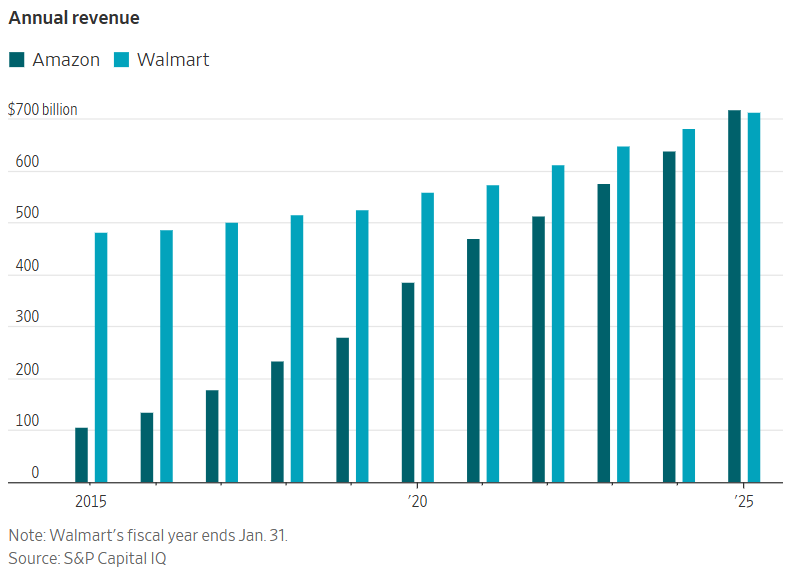
For nearly two decades, Walmart stood as the nation’s largest company by revenue, proudly branding itself a “Fortune 1” business to recruits, employees and suppliers. That era has ended.
Amazon.com, founded 31 years ago, has surpassed the 63-year-old retail giant in annual revenue. Walmart reported $713.2 billion in sales for the year ending Jan. 31, while Amazon posted $716.9 billion for its most recent fiscal year. A slim margin that reflects years of steady momentum.
Amazon’s rise from an online bookstore launched in Jeff Bezos’ garage to a sprawling force in cloud computing, artificial intelligence, entertainment and retail has steadily reshaped corporate America. Its sales grew 12.4% last year, far outpacing Walmart’s 4.7% growth. As Amazon expanded, Walmart adjusted its own business model to keep pace. Former Walmart US CEO Bill Simon described the shift bluntly: Walmart once drove the bus; now it rides it.
Walmart’s leadership anticipated losing the revenue crown and gradually shifted its messaging. Executives now emphasize becoming “America’s favorite place to shop” rather than focusing solely on size or speed of growth. Recent job postings have quietly removed references to “Fortune 1,” signaling an internal recalibration.
Amazon continues to fuel its growth with aggressive investment. It has broadened its merchandise mix to include high-ticket items such as luxury handbags and cars. Amazon plans to spend $4 billion building same-day delivery hubs in rural America and has expanded same-day grocery delivery to more than 2,300 towns. Faster delivery encourages customers to shop more frequently, a strategy that continues to pay off.
Diversifying retail in the modern era

These moves have strengthened Amazon’s grip on US retail spending. It now accounts for roughly 9% of total US retail sales, up from about 6% before the pandemic. Walmart holds about 7.6%, a share that has remained relatively steady.
Consumers increasingly embrace Amazon’s speed and convenience. Some shoppers now purchase nearly everything through the platform, from household goods to automobiles, often completing transactions in minutes rather than hours. That ease of use reinforces Amazon’s competitive advantage and challenges traditional retail habits.
Walmart continues to push back. It has expanded its online marketplace, widened same-day delivery coverage to 95% of US households and strengthened its position as the nation’s largest grocer. Surveys show that roughly 72% of US households bought groceries at Walmart in the past month, marking a notable increase from the previous year.
Amazon, meanwhile, continues refining its grocery strategy. Although it has closed several physical grocery stores, it plans to build new Whole Foods Market locations and develop a large-format retail outlet in the Chicago area that blends groceries with clothing and home goods. An approach that mirrors Walmart’s supercenter model.
The companies generate profits differently, though their models increasingly overlap. Amazon earns substantial profit from cloud computing and advertising while using fast shipping to capture retail share. Walmart relies heavily on US store sales but continues expanding its digital operations, advertising services and membership programs.
Revenues Leadership vs Retail Leadership
Although Amazon now leads in total revenue, it still depends significantly on fees from third-party marketplace sellers rather than direct merchandise sales. Walmart derives most of its revenue from selling its own inventory. Analysts suggest Amazon may need years—if ever—to overtake Walmart in pure retail sales.
Amazon’s ascent signals a shift in the balance of power in American commerce. Walmart remains a dominant retailer. However, Amazon’s faster growth, technological reach and relentless investment have secured it the top revenue position and redefined what retail leadership looks like.
Reference
Nassauer, S., & McLain, S. (2026, February 19). Amazon Is Now America’s Biggest Company. Its 17-Year Journey to Surpass Walmart. The Wall Street Journal. https://www.wsj.com/business/retail/amazon-biggest-us-company-walmart-cfd0cac4?st=nFqXvf