
“Liberation Day” put international trade upside down, Trump hit allies and rivals alike, but also revealed the weaknesses of the World Trade Organisation (WTO). Yet, global trade kept moving, with a higher trade than the forecast. Exporters have adapted fast. China rose by 6% in the first months compared to previous years and the European Union 8%, Asean by 6% and Africa by a quarter. But, even though countries are diversifying, such agility has limits.
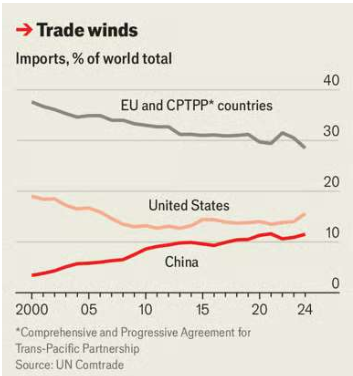
For 2026, the outcome depends on how the world responds to America’s Tariffs and China’s industrial hunger. For some, protectionism is the answer like the case of Mexico with 50% duty on some Chinese imports. Other are taking the defensive side like the EU who is preparing to quote steel quotas and double levies by 50%. South-East Asia is focusing on protecting local firms against Chinese exports.
At the same time, this has sent countries to look for a way to substitute US demand. The answer has been free-trade agreements, with the EU leading the way. It has already signed a deal with Mercosur, Indonesia and now it’s looking to India and UAE. Brazil is having talks with Canada, Japan and hopefully Mexico while Canada speaks with Indonesia and negotiation with ASEAN.
Donal Trump’s Tariffs have sent coutnries racing to strike new trade deals
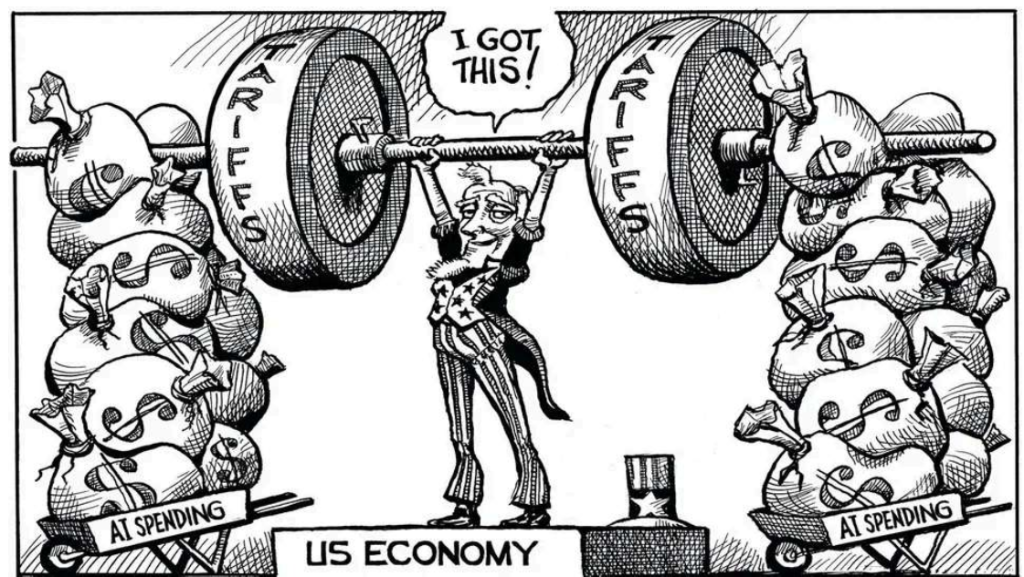
Efforts to defend the rules-based trading system are continuing, but they remain tentative and fragmented. The WTO is weakened and struggling to function, yet it has not collapsed. Even the US is selectively supporting parts of it, pushing to extend the moratorium on tariffs for digital trade and moving to appoint an ambassador. Smaller economies are still bringing cases and demanding reform, while China has pledged to abandon its developing-country status. Governments from Brazil to Indonesia openly argue that the WTO must be strengthened, though meaningful reform is expected to be slow and politically difficult.
The rules-based trading order needs a champion. Attention has turned to the EU as a possible leader and other the bloc of the Comprehensive and Progressive Agreement for Trans-Pacific Partnership. This represents 14% of global GDP and includes countries such as Japan, Canada, Mexico and Australia. While the EU already trades extensively with many CPTPP members, a formal merger appears unrealistic. The pact was designed around U.S.-style rules and lighter regulatory standards, making deep integration unlikely in the near term. Rather than a grand revival of multilateralism, the outlook points to continued fragmentation. Yet, some will make efforts to keep the order alive.
Reference
Domash, A. (2025, November 12). Global Trade will continue, but will become more complex. The Economist. https://www.economist.com/the-world-ahead/2025/11/12/global-trade-will-continue-but-will-become-more-complex