
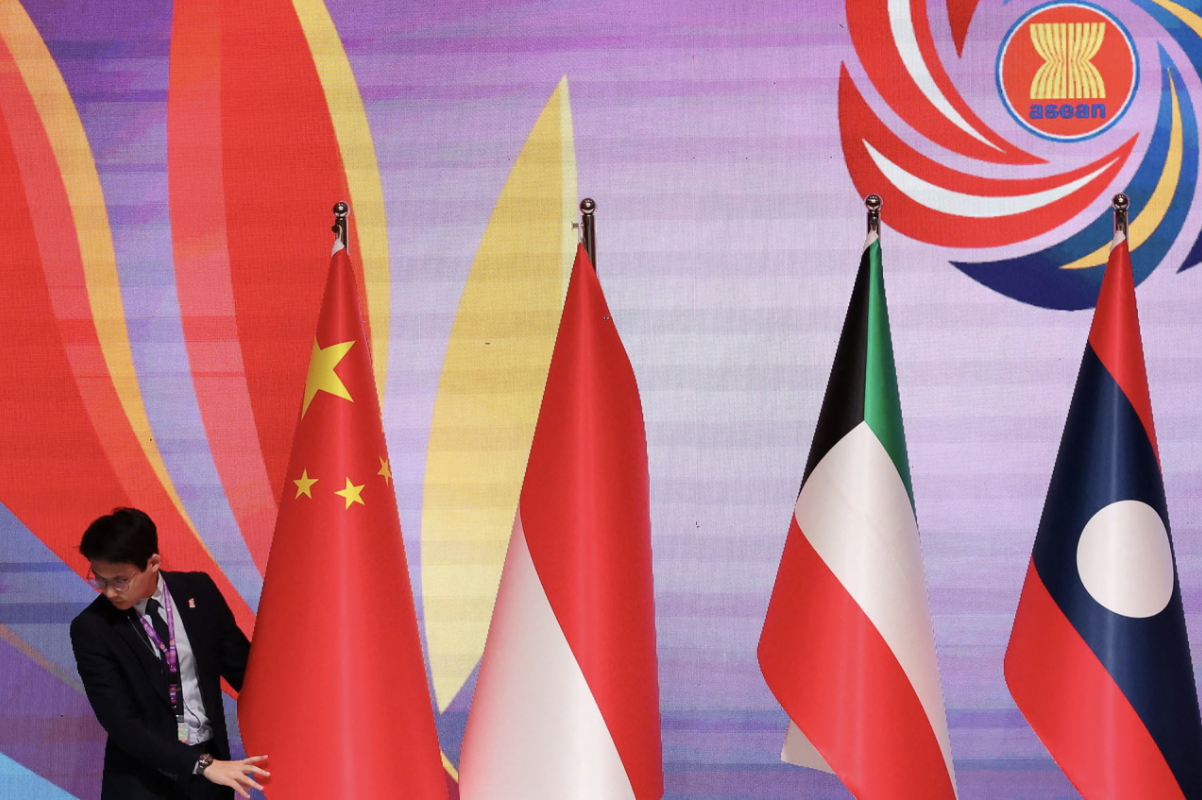
The Transition from “Hedging” to “Pragmatic Alignment”
By April 2026, the nations of Southeast Asia have transitioned from a policy of “hedging”—balancing relations between Washington and Beijing—to a posture of Pragmatic Alignment with China. The CFR report highlights that the U.S. preoccupation with the Iran war and the “Stone Age” ultimatum (Article #90) has signaled to ASEAN members that the U.S. is an unreliable security guarantor.Consequently, states that once looked to the U.S. for maritime security are now prioritizing economic stability through closer ties with the Regional Comprehensive Economic Partnership (RCEP). This suggests that the “Indo-Pacific Strategy” has been effectively decapitated by the distraction of a Middle Eastern conflict.
Origins and the “Energy Insecurity” Catalyst
Originally, Southeast Asian nations were wary of China’s maritime claims but remained dependent on American security umbrella. However, the origin of the current shift lies in the U.S. Blockade of the Strait of Hormuz. By weaponizing energy flows to pressure Iran, the U.S. inadvertently triggered an energy crisis in Thailand, Vietnam, and Indonesia. For 2026, China has stepped into this vacuum, offering “State-to-State” energy guarantees and infrastructure investment that the U.S. cannot match. Furthermore, the report emphasizes that the April 8 NATO Withdrawal Threat (Article #97) has convinced Asian leaders that the U.S. is entering a phase of terminal isolationism.
The Structure of “Soft Power” Displacement
The structure of U.S. displacement in the region is organized around three “Pull Factors” toward Beijing:
- Infrastructure Sovereignty: China’s “Belt and Road” 2.0 projects are focusing on digital and green energy grids that integrate directly with Southeast Asian urban centers.
- The Non-Interference Doctrine: Unlike the U.S., which uses “values-based” diplomacy, China offers a model of “Stability-First” governance that appeals to the region’s diverse political systems.
- Institutional Friction: The article highlights the frustration within the ASEAN Secretariat, where leaders feel that U.S. sanctions on Iran are “Secondary Colonialism” that forces them to pay higher prices for fuel without any strategic benefit.
Synthesis of the “Distraction” Trap and the New Bipolarity
The successful push of Southeast Asia toward China now faces a paradox where the U.S. attempt to demonstrate “Global Strength” in Iran has resulted in Regional Weakness in Asia. This represents a failure of Grand Strategy, where a tactical focus on one adversary leads to a systemic loss across the board. There is a clear intent among ASEAN nations to maintain their “Centrality,” but the geopolitical gravity of Beijing is becoming inescapable as the U.S. withdraws its presence. Ultimately, it is clear that the Iran war has served as the final proof for many in the Global South that the American era is a “Security Liability” rather than an asset.
Reference
Council on Foreign Relations. (2026, April 9). The U.S. is pushing Southeast Asia toward China; The Iran war made it worse. CFR Asia-Pacific Briefs. https://www.cfr.org/articles/the-u-s-is-pushing-southeast-asia-toward-china-the-iran-war-made-it-worse