
In the article “The Supreme Court’s Tariff Decision Could Affect Trump’s China Negotiations,” published by the Council on Foreign Relations, Zongyuan Zoe Liu analyzes how a recent U.S. Supreme Court ruling reshapes the legal framework of American trade policy toward China. The decision determined that the International Emergency Economic Powers Act (IEEPA) does not authorize tariffs. As a result, the ruling limits unilateral presidential authority and forces the United States to rely more heavily on formal legal procedures and congressional involvement in future trade measures. The decision does not end tariff confrontation with China. However, it changes the speed, credibility, and structure of U.S. economic pressure in ongoing negotiations.
Legal Limits on Presidential Tariff Authority
The Supreme Court’s ruling directly affects tariffs imposed under emergency powers. Specifically, it invalidates tariffs that relied solely on IEEPA authority, including the Trump administration’s ten-percent “fentanyl emergency” tariffs on Chinese imports and other reciprocal tariffs applied to multiple trading partners.
For U.S. importers, the ruling could trigger large refund claims through the U.S. Court of International Trade. For the White House, the decision removes one of the fastest tools available to the executive branch. Previously, presidents could impose tariffs quickly by declaring an economic emergency. Now, that path is no longer legally sustainable.
However, the broader architecture of U.S. tariffs on China remains largely intact. Tariffs implemented under Section 301 investigations dating back to 2018 still form the backbone of U.S. trade pressure. In addition, Section 232 national security tariffs and anti-dumping duties issued by the Commerce Department remain unaffected by the Court’s decision.
Implications for U.S.–China Negotiations
Although the ruling does not dismantle the existing tariff structure, it alters the political incentives surrounding future trade actions. In the past, presidents from both parties used emergency authorities as flexible tools of economic statecraft. The Supreme Court has now clarified that this flexibility has legal limits.
As a result, future tariff escalation may slow down. New trade restrictions will likely require reliance on narrower statutes or negotiations with Congress. Consequently, the era of instantaneous tariff retaliation is constrained, even if it has not completely disappeared.
From Beijing’s perspective, the ruling provides a modest tactical advantage. Chinese officials can now argue that American tariff threats are constrained by constitutional limits. In turn, this strengthens China’s narrative that U.S. economic coercion is controversial not only internationally but also within the United States.
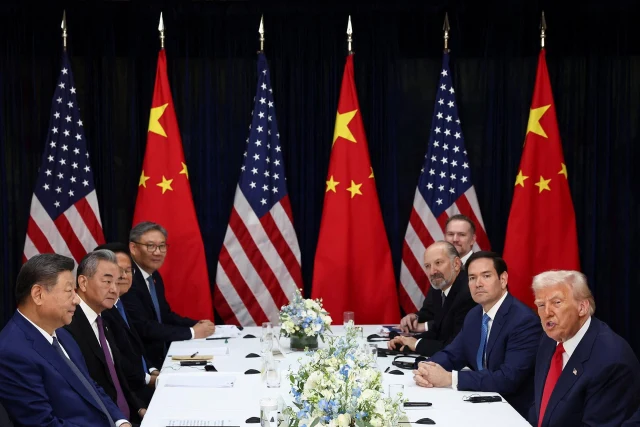
The decision also affects the diplomatic environment ahead of potential negotiations between President Donald Trump and Chinese President Xi Jinping. Without IEEPA as a rapid tariff instrument, Washington enters talks with fewer unilateral tools. Chinese negotiators may therefore see the ruling as slightly improving their bargaining position.
Economic and Business Implications
The ruling also carries significant implications for businesses and global supply chains. In the short term, companies must reassess the legal status of existing tariffs and determine whether they qualify for refunds. Compliance teams will also need to examine the statutory basis behind different tariff measures.
However, the ruling could produce greater predictability in the medium term. When trade policy moves through formal legal channels, it tends to evolve more slowly. For multinational corporations, slower policy changes often translate into more stable expectations.
At the same time, economic statecraft typically relies on credible and rapid threats. By limiting emergency tariff authority, the Court reduces the speed with which the United States can escalate trade pressure. This change could weaken one dimension of U.S. bargaining leverage in future trade disputes.
Alternative Trade Tools for the United States
Despite these constraints, the U.S. government still retains several legal pathways to impose tariffs on China. The Trump administration has already begun exploring alternative statutory tools.
One option is Section 122 of the Trade Act, which allows temporary tariffs of up to 15 percent for a period of 150 days. This measure provides short-term leverage while the administration pursues longer investigations under other legal authorities.
Another pathway involves Section 301 investigations, which address unfair trade practices. Although these investigations take months to complete, they can lead to more durable tariff measures.
The administration may also rely on Section 232 national security tariffs, particularly in strategic sectors such as semiconductors and medical equipment. In addition, officials could consider invoking Section 338 of the Tariff Act of 1930, a rarely used provision that allows tariffs of up to 50 percent on countries that discriminate against U.S. commerce.
Implications for the Future of U.S.–China Trade Conflict
The Supreme Court’s ruling does not fundamentally alter the strategic rivalry between the United States and China. Structural tensions—including technological competition, industrial policy disputes, and security concerns, remain unchanged.
Nevertheless, the decision reshapes how economic confrontation between the two countries unfolds. Tariff conflicts will now operate within clearer statutory limits. Consequently, trade wars may become less improvisational and more institutionalized.
Washington still possesses powerful economic tools. However, deploying them will now require more procedure, more political consensus, and more time. Beijing gains a small tactical advantage from this shift, but it does not escape long-term strategic pressure.
In that sense, the Court’s ruling does not end tariff conflict. Instead, it transforms it into a more regulated contest shaped by legal constraints as well as geopolitical rivalry.
Liu, Z. Z. (2026, February 23). The Supreme Court’s tariff decision could affect Trump’s China negotiations. Council on Foreign Relations. https://www.cfr.org