
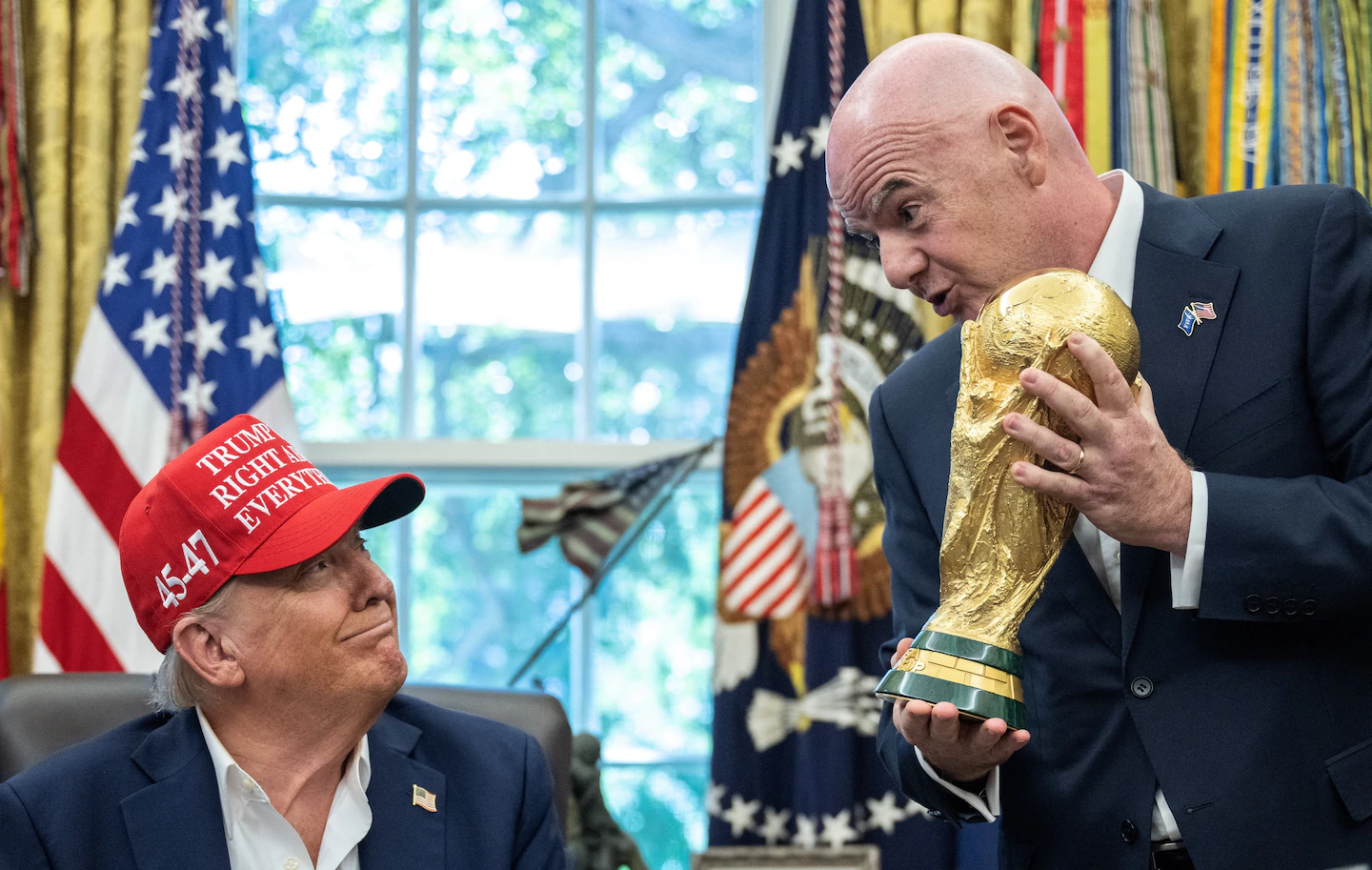
The author reflects on how the 2026 World Cup will begin to take shape. This as leaders from the United States, Mexico, and Canada gather for the official tournament draw. While the event brings excitement for global soccer fans, the article notes that President Trump is expected to use the World Cup’s visibility for political gain. Even receiving a newly invented FIFA “peace prize.” All the glamour surrounding the tournament risks overshadowing concerns such as soaring ticket prices and U.S. immigration barriers that may complicate travel for international fans.
The article highlights how the World Cup has always been deeply intertwined with politics. The author discusses insights from Jonathan Wilson. He is the autohr of The Power and the Glory traces how the tournament has been used for national prestige, propaganda, and global influence. He also had an interview with Wilson to understand more in depth the importance of the event. Wilson explains that unlike the Olympics, the World Cup unites nearly the entire world around one sport, making it a powerful cultural symbol often exploited by political leaders.
The World Cup’s Long History of Political Theather

Wilson explains that the 1934 tournament became a carefully engineered propaganda project under Benito Mussolini. Although Mussolini personally preferred predictable individual sports, he recognized the immense symbolic power of football. After securing hosting rights over Sweden, he transformed the event into a showcase of fascist strength. The regime invested heavily in branding, merchandising, and stagecraft. Beautifully crafted memorabilia, high-quality tickets stamped with fascist symbols, and even the creation of the oversized Copa del Duce, designed to visually dwarf the official Jules Rimet trophy.. Wilson presents this as one of the earliest and clearest examples of a government using the World Cup as a tool of national propaganda.
The conversation shifts to contemporary power dynamics, where Wilson highlights the growing influence of wealthy Gulf states over global football. He points to how the path was cleared for Saudi Arabia to host the 2034 World Cup and how Qatar was granted the 2022 tournament despite widespread concerns about rights and infrastructure. Wilson warns that FIFA has become dependent on Middle Eastern financial power, shaping decisions about hosting, broadcasting, and even club ownership across Europe. While acknowledging that the sport naturally evolves, he argues that when host nations clearly violate FIFA’s stated principles, the organization’s credibility becomes compromised. His caution reflects a broader anxiety about governance, transparency, and the ethical direction of world football.
Conclusions
The summary also underscores Wilson’s argument that any host nation deserves scrutiny, including the United States. He points to issues like restrictive immigration policies and a broader hostility toward foreign visitors. Which could undermine the inclusive spirit historically associated with the World Cup.
The piece closes with a reflection on nostalgia. The author recalls earlier tournaments as more distinctive and magical, before modern stadium design and constant global soccer coverage made the event feel more standardized. Even as viewing numbers remain strong, the article suggests that some of the World Cup’s mystique has faded over time.
Reference
Tharoor, I. (2025, December 4). The World Cup has always been about politics. The Washigton Post. https://www.washingtonpost.com/world/2025/12/05/worldview-fifa-politics/