
Preventive Priorities Survey – Center for Preventive Action (December 2025)
A More Violent and Disorderly World
The 2026 edition of Conflicts to Watch reflects heightened concern among U.S. foreign policy experts about escalating global instability. Conducted through the Preventive Priorities Survey (PPS), the assessment ranks thirty contingencies according to their likelihood and potential impact on U.S. interests. As stated in the report’s overview, the world continues to grow more violent and disorderly, and policymakers are frequently blindsided by conflict-related crises Top Conflicts to Watch in 2026.
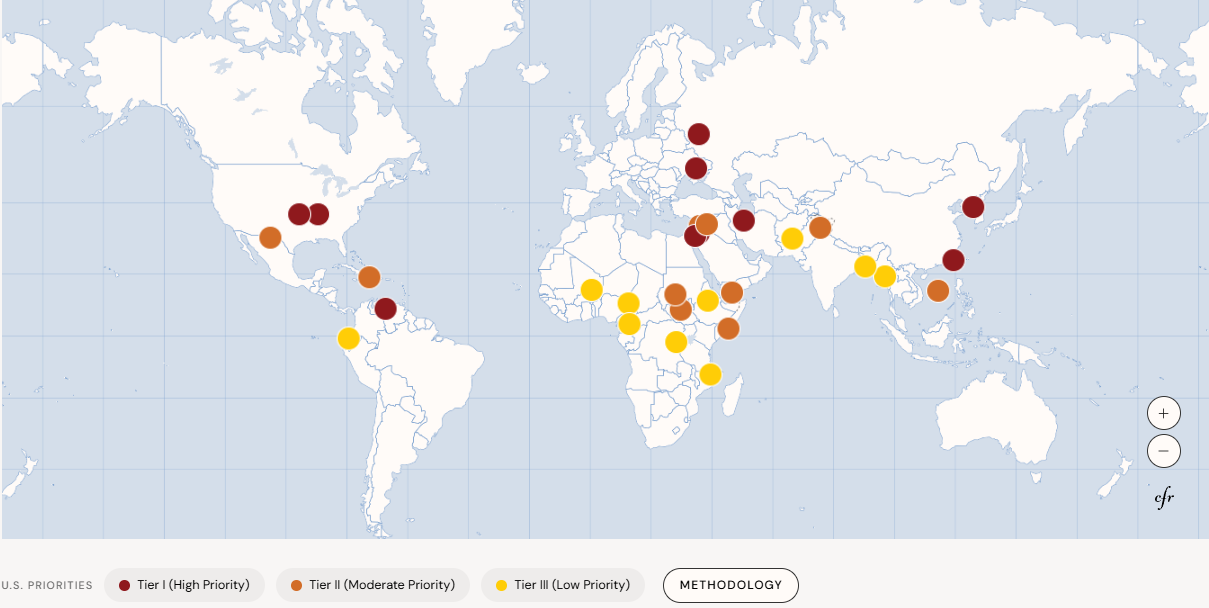
The survey categorizes conflicts into three tiers:
- Tier I (High Priority): High likelihood and/or high impact on U.S. interests.
- Tier II (Moderate Priority): Significant but comparatively lower risk.
- Tier III (Low Priority): Limited probability or impact.
The first map visualizes these priorities geographically, highlighting concentrations in Europe, the Middle East, and parts of East Asia.
Tier I: High Likelihood, High Impact
Among the most urgent contingencies, experts identify:
- Renewed fighting in Gaza and escalating Israeli-Palestinian tensions in the West Bank.
- An intensified phase of the Russia–Ukraine war.
- Expanded confrontation between Iran and Israel.
- Severe crises in the Taiwan Strait involving China.
- Potential escalation between Russia and NATO member states.
- Major cyberattacks targeting U.S. critical infrastructure.
The assessment matrix plots contingencies by likelihood and impact, emphasizing that several Tier I risks combine both high probability and high strategic consequences Top Conflicts to Watch in 2026.
Notably, while the South China Sea remains strategically sensitive, experts rated the risk of direct conflict there as lower in likelihood for 2026).
Tier II and Tier III: Persistent Instability
Tier II contingencies include civil war in Sudan, violence in Haiti, conflict spillover in Lebanon, instability in Syria, and renewed India–Pakistan tensions. These risks are judged moderately likely or moderately impactful but still capable of destabilizing key regions.
Tier III contingencies focus largely on sub-Saharan Africa and fragile states, including conflicts in the Sahel, Ethiopia–Eritrea tensions, instability in Mozambique, and unrest in Cameroon. While these crises may not directly threaten U.S. national security at the same level as Tier I events, they carry severe humanitarian consequences.
The report also lists “Other Noted Concerns”, including Arctic militarization, Azerbaijan–Armenia tensions, and renewed unrest in Cambodia–Thailand border areas Top Conflicts to Watch in 2026.
Preventive Opportunities and Strategic Outlook
A distinctive feature of the 2026 survey is its emphasis on prevention. Experts identified several scenarios where U.S. diplomatic engagement could meaningfully mitigate escalation, including:
- Gaza ceasefire stabilization.
- De-escalation in Taiwan.
- Reducing the risk of U.S.–Iran confrontation.
- Managing Russia–Ukraine spillover risks.
The report concludes that anxiety about global conflict remains high and that many top-tier contingencies are recurring threats from previous years Top Conflicts to Watch in 2026.
Overall, Conflicts to Watch in 2026 underscores a strategic environment characterized by overlapping wars, great-power rivalry, proxy confrontations, and technological risks such as cyber conflict making preventive diplomacy increasingly urgent.
Reference
Center for Preventive Action. (2025, December). Conflicts to watch in 2026: Preventive priorities survey results. Council on Foreign Relations. https://www.cfr.org/