
Food Loss and Waste as a Structural Challenge in the APEC Region
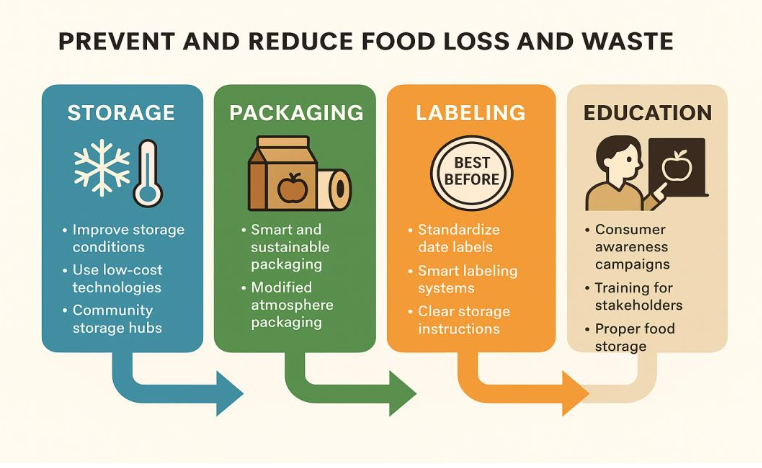
Food loss and waste remain a persistent structural challenge across food systems, particularly during storage, packaging, distribution, and final consumption stages. Globally, inadequate packaging, weak cold chains, and poor handling practices contribute significantly to avoidable losses, especially in developing economies. At the same time, household food waste continues to rise, driven partly by upstream inefficiencies and consumer confusion regarding food quality and safety. Packaging therefore emerges as a critical intervention point, capable of expanding shelf life, improving food safety, and enabling longer distribution channels, while also supporting food security objectives across the Asia-Pacific region. Importantly, poor packaging alone can account for up to one-fifth of total food waste, positioning packaging innovation among the most impactful solutions available. Against this backdrop, APEC economies have increasingly framed food loss and waste reduction as both a food security and sustainability priority, closely aligned with circular economy principles and climate mitigation goals.
Within this context, the workshop emphasized the importance of shifting from fragmented responses toward system-based approaches. Improved data quality, shared definitions, and harmonized measurement framework were identified as prerequisites for effective policymaking. While progress varies widely among economies, downstream stages such as processing, retail, and consumption continue to generate the fastest growth in losses, particularly for vegetables and cereals. Consequently, targeted interventions at these stages offer the greatest potential for immediate impact.
Packaging Innovation, Technology and Policy Alignment
Packaging innovation was consistently presented as a powerful lever for reducing food loss and waste across the supply chain. Advances in active, intelligent, and modified-atmosphere packaging demonstrate measurable improvements in freshness preservation, microbial control, and shelf-life extension. Technologies such as ethylene adsorption, oxygen regulation, humidity control, and smart indications allow food to remain edible for longer periods without compromising safety. At the same time, innovations in grain storage, including hermetic packaging and anti-mycotoxin solutions, have shown substantial reductions in pest damage and fungal contamination, particularly in staples crops. These developments underscore how science-driven packaging solutions can simultaneously address economic losses, public health risks, and trade barriers.
However, technological progress alone is insufficient without supportive regulatory and market conditions. Several economies highlighted tensions between sustainability goals and packaging regulations, particularly concerning recyclability, cost, and material safety. While high-barrier packaging effectively reduces spoilage, it often creates recycling challenges, promoting renewed interest in mono-material designs, bio-based coatings, and upcycled inputs. In response, policy coordination and public-private partnerships were repeatedly identified as essential mechanisms for scaling innovation. Collaborative models linking governments, industry and research institutions have already delivered tangible results, including reduced unsold food rates, improved donations systems, and stronger incentives for waste prevention at the source.
Consumer Behavior, Date labeling, and Collective Action
Beyond production and distribution, consumer behavior plays a decisive role in determining overall food waste outcomes. Confusing date labels, inconsistent regulations, and limited food literacy contribute to premature disposal and edible food. The workshop highlighted growing evidence that clearer distinctions between safety-based and quality-based dates can significantly reduce household waste. Moreover, packaging itself can function as an educational tool by offering storage guidance, usage suggestions, and behavioral cues that encourage more responsible consumption. When combined with public awareness campaign, these measures help rebuild trust and understanding between consumers and food systems.
Importantly, effective food loss and waste reduction requires coordination across scales, from local infrastructure investments to regional policy frameworks. APEC’s midterm review revealed uneven progress but also demonstrated the value of shared platforms for knowledge exchange and capacity building. Economies that integrated food donation laws, circular economy initiatives, and private-sector engagement showed more consistent improvements. Looking forward, continued collaboration, investment ambitious reduction targets translate into measurable outcomes. By integrating packaging innovation, consumer education and institutional cooperation, APEC economies can move closer to resilient, efficient, and sustainable food systems by 2030.
Source:
Asia-Pacific Economic Cooperation. (2026). Workshop on reducing food loss and waste through packaging innovations and progress review of FLW in the APEC region (APEC Project No. 226-AT-04.1). APEC Secretariat. https://www.apec.org