
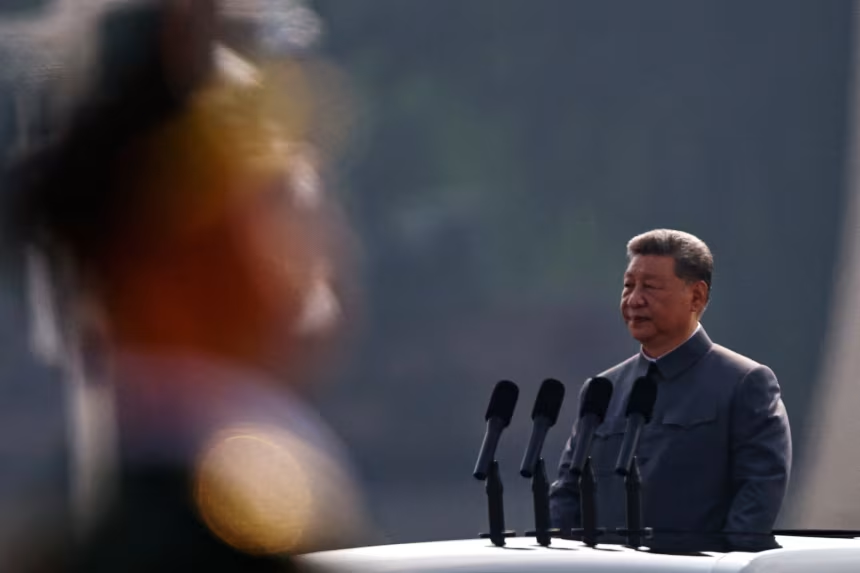
Chinese leader Xi Jinping has launched a sweeping and deeply symbolic purge at the very top of China’s military. He has placed two of its most senior commanders under investigation and left himself virtually alone at the apex of the armed forces. The move sends a stark message. No rank, relationship, or shared revolutionary lineage places anyone beyond Xi’s reach as he reshapes the People’s Liberation Army around absolute loyalty to his authority.
The investigations target Zhang Youxia, a veteran general and longtime Xi ally, and Liu Zhenli, head of the PLA’s joint operations command. An editorial in the PLA Daily accused them of undermining the principle that ultimate authority rests with the chairman of the Central Military Commission. A clear signal that Xi viewed their actions as a threat to his personal control. Analysts describe the downfall of Zhang in particular as extraordinary, given his deep personal and political ties to Xi, underscoring how far the purge has escalated.
This crackdown marks the culmination of a more than decade-long campaign that has steadily climbed the military hierarchy. Since 2023 alone, more than 20 senior officers and defense executives have fallen under investigation. Experts argue that rather than revealing weakness, the purge highlights Xi’s dominance and his belief that corruption, factionalism, or divided loyalties pose existential risks to party rule.

Central Military Commission Vice Chairman Zhang Youxia attended the National People’s Congress in Beijing last March.
Tingshu Wang/Reuters
Xi’s ‘unassailable position’
Details surrounding the allegations remain opaque, fueling speculation both inside and outside China. Reports have hinted at accusations ranging from corruption to leaking sensitive military information, though these claims remain unverified. Some observers suggest such charges may serve to justify the purge internally. Meanwhile others see evidence of Xi eliminating rival power centers or preempting challenges to his authority.
What remains clear is Xi’s long-standing objective: to ensure the military serves the Communist Party, and himself, above all else. Since taking power in 2012, he has paired ambitious modernization and reorganization efforts with relentless political discipline. Action that has been driven by lessons drawn from authoritarian regimes that collapsed after losing control of their armed forces.
‘State of disarray’
The immediate result is a hollowed-out leadership. Of the six uniformed members of the Central Military Commission appointed in 2022, only one remains untouched. Analysts describe the upper ranks as thin and unsettled, with few experienced generals left in place. Xi has begun relying on second-tier officers to fill gaps on an interim basis, while quietly vetting potential successors ahead of the next leadership reshuffle.
Despite the upheaval, daily military operations continue, supported by a younger, more professional officer corps. Still, questions loom over morale, command cohesion, and the impact on China’s strategic ambitions, especially regarding Taiwan. Liu’s role in overseeing combat readiness sharpens those concerns.
Some analysts believe Xi views this moment as strategically safe for internal cleansing. With Washington showing limited focus on Taiwan and no immediate electoral shift expected on the island until 2028, Xi may see an opportunity to eliminate lingering patronage networks and consolidate control before any future confrontation.
Reference
McCarthy, S. (2026, January 26). Xi has absolute control over China’s military. Now he wants more. CNN. https://edition.cnn.com/2026/01/26/china/xi-jinping-zhang-youxia-military-probe-intl-hnk