
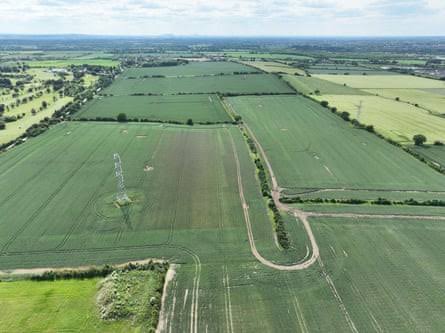
Planning documents for the proposed £14.7bn East Havering Data Centre Campus in outer London reveal that the site would generate 1.2 million tonnes of carbon dioxide. In short, equivalent annually when fully operational, an impact comparable to nearly 27,000 flights between London and New York. The 218-hectare project would occupy local green belt farmland to support infrastructure for artificial intelligence and cloud computing. The developer admits in its submission that the project fails to align with 1.5°C climate trajectories or net-zero goals. In addition, with operational emissions expected to generate over 72 million tonnes of greenhouse gases across a 60-year lifespan.
At a typical load, the facility would consume 2.65 billion kilowatt-hours of electricity per year. Obviously, equivalent to the power required by over one million households, necessitating significant additions to the local power grid. Environmental advocates and local resident organizations have criticized the development as a threat to national decarbonization targets, agricultural land, and energy infrastructure. Taking note, that by 2038 its operational emissions would account for nearly one percent of the entire UK carbon budget. To compensate for off-site emissions, the developer proposes a £77.6m contribution to the borough’s carbon offset fund. Even though critics argue tech firms should instead be legally obligated to build dedicated renewable energy sources.
In conclusion, the East Havering proposal highlights a growing conflict between the expansion of energy-intensive AI infrastructure and legal commitments to meet net-zero carbon targets. Ultimately, demonstrating that financial offsets may be insufficient to counteract the massive grid demands and environmental costs of hyperscale developments.
Reference
Pearce, M. (2026, August 21). Proposed London datacentre ‘incompatible’ with net zero with 1m-tonne carbon footprint. The Guardian; The Guardian. https://www.theguardian.com/uk-news/2026/aug/21/proposed-london-datacentre-will-have-annual-carbon-footprint-of-27000-flights-to-new-york