
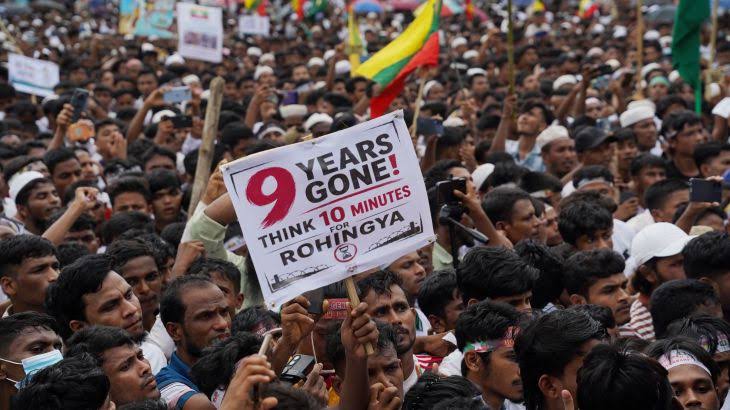
Hundreds of Rohingya refugees gathered in Cox’s Bazar, Bangladesh, to mark the ninth anniversary of the 2017 military crackdown in Myanmar. In short, demanding justice, full citizenship rights, and a safe return to their homeland. Nearly 1.2 million stateless Rohingya reside in overcrowded Bangladeshi camps, where living conditions are deteriorating rapidly due to severe global aid reductions. International funding appeals have seen substantial cuts, forcing agencies to reduce basic food rations and essential services. This humanitarian strain is further compounded by hostile policies in host nations across the region, where displaced individuals face forced evictions and deportations. This leaving many with no choice but to undertake dangerous maritime journeys in search of safety.
While international bodies and foreign governments officially recognize the 2017 atrocities as genocide, meaningful political resolution and justice remain elusive. Legal proceedings at the International Court of Justice and the International Criminal Court remain stalled without final rulings or public indictments. Meanwhile, political instability and persistent violence inside Myanmar continue to prevent safe repatriation, leaving refugees trapped in prolonged exile with limited access to education or economic opportunities.
In conclusion, the ongoing protest in Cox’s Bazar underscores a growing sense of desperation among the stateless Rohingya population. The convergence of steep humanitarian aid cuts, lack of legal accountability for atrocities, and unsafe conditions for return in Myanmar. Ultimately, has created an enduring crisis, leaving over a million refugees stranded in precarious conditions without a clear path toward justice or permanent resolution.
Reference
Shamim, S. (2026, August 25). Why Rohingya refugees are protesting in Cox’s Bazar, 9 years after genocide. Al Jazeera. https://www.aljazeera.com/news/2026/8/25/why-rohingya-refugees-are-protesting-in-coxs-bazar-9-years-after-genocide