
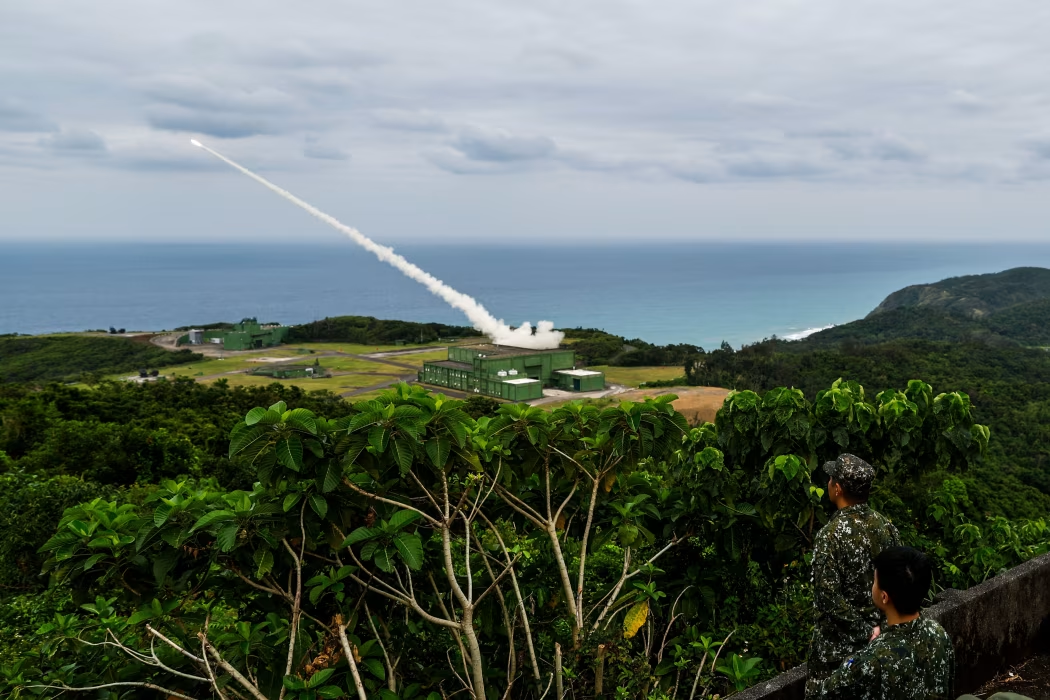
President Trump sought to reassure Asian allies concerned about his China policy by approving one of the largest U.S. arms sales to Taiwan. An $11.1 billion package centered on Hilmar’s rocket systems and artillery meant to deter a potential Chinese attack. The move was welcomed in Washington, where bipartisan support for Taiwan remains strong. Which mitigated fears that Trump might trade away U.S. commitments to the island in pursuit of closer ties with Beijing.

President Trump and Chinese leader Xi Jinping ahead of a meeting in Busan, South Korea, in October.
The timing of the sale, however, underscored lingering unease. It came alongside a bipartisan congressional report warning that China is exploiting doubts about U.S. resolve by escalating military pressure on Taiwan. Lawmakers stressed that Taiwan “is not—and will not be—a bargaining chip.” Reflecting anxiety that Trump’s transactional diplomacy and repeated expressions of personal warmth toward President Xi Jinping could weaken deterrence.
Those concerns have been fueled by a series of administration actions and statements. Trump has downplayed the likelihood of a Chinese invasion. Framed Taiwan largely as an economic competitor, blocked a stopover by Taiwan’s president in the U.S., and urged Japan to avoid provoking Beijing. Allies in the region have drawn uncomfortable parallels between Trump’s approach to China and his past posture toward Russia. Worrying that Taiwan could face a fate similar to Ukraine’s.
Strong Military Signals
At the same time, critics acknowledge that failing to approve arms sales would have sent an even more damaging signal. “It tempers my criticism,” said retired Rear Adm. Mark Montgomery called the deal “what a partner does for a good ally.” Supporters argue the sale reflects continuity in U.S. policy, driven by Congress and the defense establishment, regardless of who occupies the White House. Figures across administrations praised the move as aligning U.S. actions with long-standing commitments to Taiwan’s defense.
The arms package fits within a broader U.S. strategy aimed at preserving military superiority in Asia and deterring unilateral changes to the status quo. Yet tensions remain over Trump’s softer rhetoric compared with his predecessor. Besides, the National Security Strategy has framed Taiwan’s importance primarily in economic terms rather than democratic values.

A Taiwanese assault boat was on guard in July during a military exercise in the southern port city of Kaohsiung
For Taiwan, the weapons, particularly the Himars systems capable of striking targets along China’s coast, are seen as strengthening deterrence by raising the cost. Still, public opinion on the island reflects unease about Trump’s transactional style. A fear in which U.S. support could ultimately be negotiated away in a broader deal with Beijing.
Reference
Areddy, J. T. (2025, December 18). Trump Tackles Concerns Over Taiwan Strategy With Massive Weapons Deal. The Wall Street Journal. https://www.wsj.com/world/china/trump-tackles-concerns-over-taiwan-strategy-with-massive-weapons-deal-211d2528?st=Dsr9b5