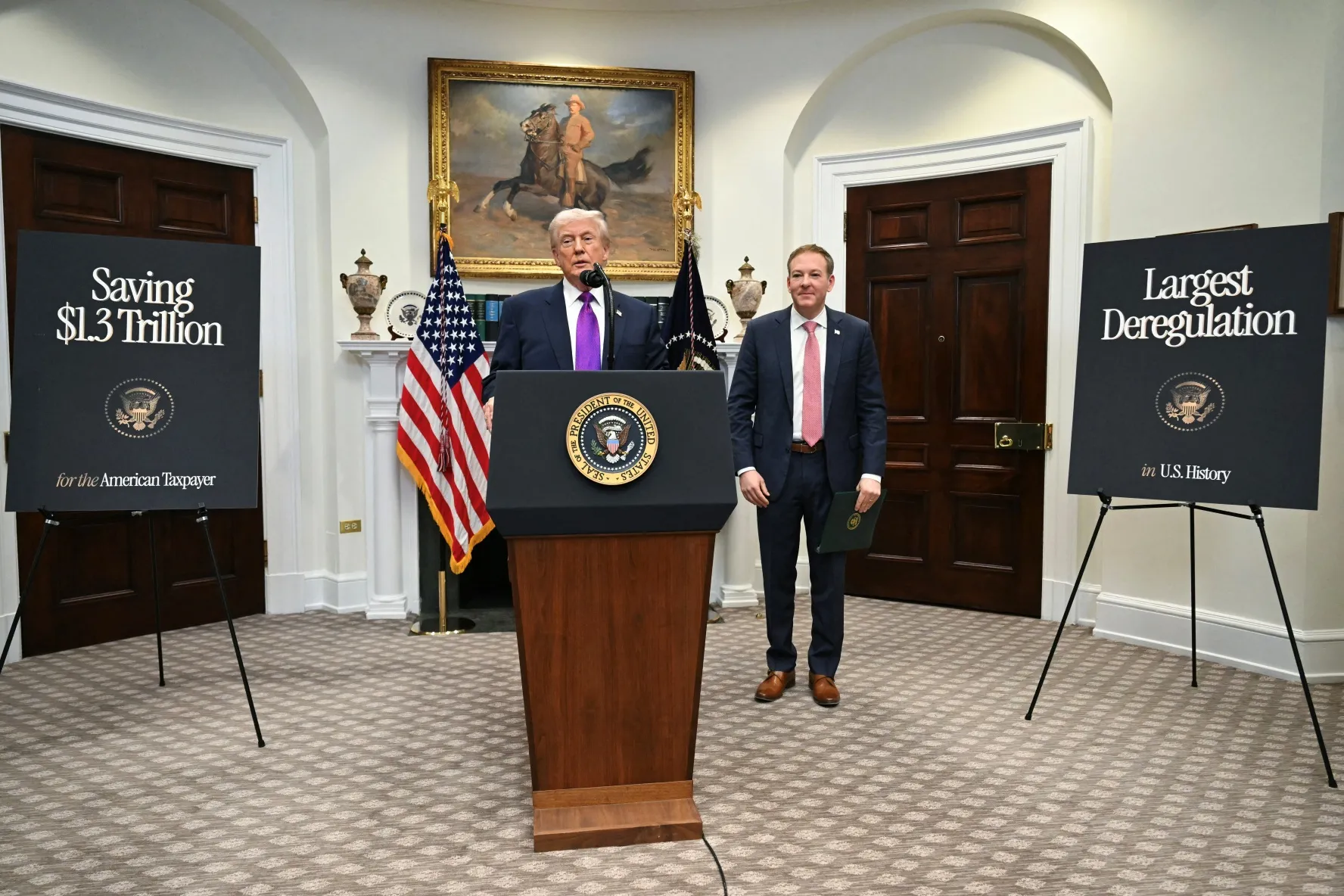
US President Donald Trump joined by US Administrator of the Environmental Protection Agency, EPA, Lee Zeldin, makes an announcement in the Roosevelt Room of the White House in Washington, DC on February 12, 2026.

Industrial Backlash to Climate Deregulation in the United States

The Paradox of Deregulation and Market Stability 
In a detailed 2025 analysis, the Brookings Institution examines the Trump administration’s aggressive efforts to dismantle established climate and environmental regulations. While traditional conservative economic theory suggests that reducing the federal regulatory burden should be universally welcomed by the private sector, the current reality is far more complex. Consequently, many major industrial players, from automakers to energy utility providers, have expressed significant concern over the potential for market chaos. The core issue is that many of these firms have already invested billions of dollars in “green” transitions and now fear that a sudden regulatory vacuum will create a “patchwork” of conflicting state-level rules, undermining their long-term strategic planning.
Origins and the Shift in Corporate Environmental Strategy 
Originally, the relationship between federal regulators and heavy industry was characterized by constant litigation and resistance to environmental mandates. However, over the last decade, the global shift toward ESG (Environmental, Social, and Governance) standards and the rise of the People’s Republic of China as a leader in green technology forced U.S. industry to adapt. The Brookings report suggests that the origin of the current industry anxiety lies in the “sunk cost” of these investments. Furthermore, as the international community moves toward carbon border adjustments, U.S. companies fear that being decoupled from federal climate standards will make their exports less competitive in the European and Asian markets.
Structure of the Regulatory Rollback and Legal Uncertainty 
The structure of the administration’s dismantling effort is organized around executive orders aimed at weakening the Environmental Protection Agency’s (EPA) oversight of methane emissions and vehicle fuel efficiency standards. Specifically, the administration has sought to revoke the long-standing waivers that allowed states like California to set their own, more stringent climate rules. Moreover, the report highlights that this “top-down” deregulation often leads to a “legal quagmire” as environmental groups and blue states launch immediate judicial challenges. This structured instability is precisely what industry leaders loathe, as it prevents the “regulatory certainty” required to justify large-scale capital expenditures in infrastructure and new product lines.
Synthesis of Competitive Synergy and Global Standards 
The successful future of U.S. industrial competitiveness relies on a synergy between federal policy and the inescapable global trend toward decarbonization. This objective is essential to ensure that American firms are not left behind in the race for the next generation of industrial technology. Simultaneously, there is a clear intent among corporate leaders to maintain some level of federal standards to avoid the “race to the bottom” that could damage their brand reputation and long-term viability. Ultimately, the 2025 Brookings report provides a stable roadmap for understanding that in the modern global economy, “less regulation” does not always equate to “better business,” especially when it conflicts with the unavoidable reality of the global energy transition.
Reference
Brookings Institution. (2025). Trump is dismantling climate rules. Industry is worried. Brookings. https://www.brookings.edu/articles/trump-is-dismantling-climate-rules-industry-is-worried/