
Origins and Objectives
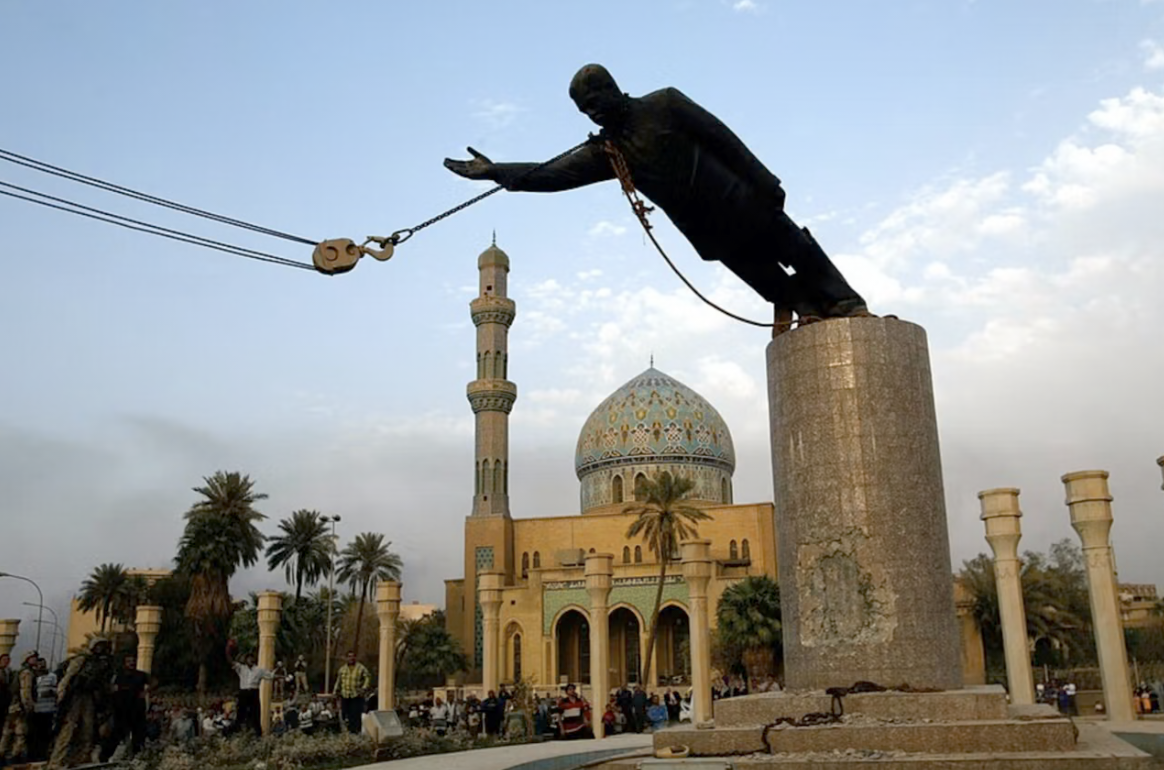
Initially, Operation Iraq Freedom was launched to remove Saddam Hussein, eliminated alleged weapons of mass destruction, and liberate Iraq under a U.S.-led coalition.
Coalition and Early Success
Moreover, after failing to gain UN approval, the United States formed a “coalition of the willing”, with limited combat participation beyond key allies.
Subsequently, rapid advances toward Baghdad and the regime’s collapse created expectations of an easy and decisive victory.
Absence of Weapons of Mass Destruction
However, once major combat ended, no weapons of mass destruction were found, contradicting prewar intelligence assessments.
Consequently, later investigations concluded that prewar judgments about Iraq’s weapons programs were fundamentally incorrect.
Collapse of the Iraqi State
Meanwhile, early public support in the United States rose dramatically, reflecting optimism after the fall of Hussein’s regime.
Nevertheless, expectations that Iraqi institutions would remain intact proved wrong as the state rapidly disintegrated.
Insurgency and Instability
As a result, widespread looting and violence evolved into a prolonged and brutal insurgency across the country.
Thus, the postwar phase became far more complex than anticipated, challenging initial assumptions about reconstruction and governance.
Strategic Miscalculations
In hindsight, prewar warnings about the consequences of regime change gained relevance as instability deepened.
Therefore, the conflict revealed significant gaps between planning assumptions and realities on the ground.
Lasting Significance
Ultimately, Operation Iraqi Freedom illustrates how rapid military success can be followed by prolonged political and security challenges.
Source:
Council on Foreign Relations. (s. f.). Remembering Operation Iraqi Freedom. https://www.cfr.org/articles/remembering-operation-iraqi-freedom