
The Shift from Impunity to Youth Political Agency
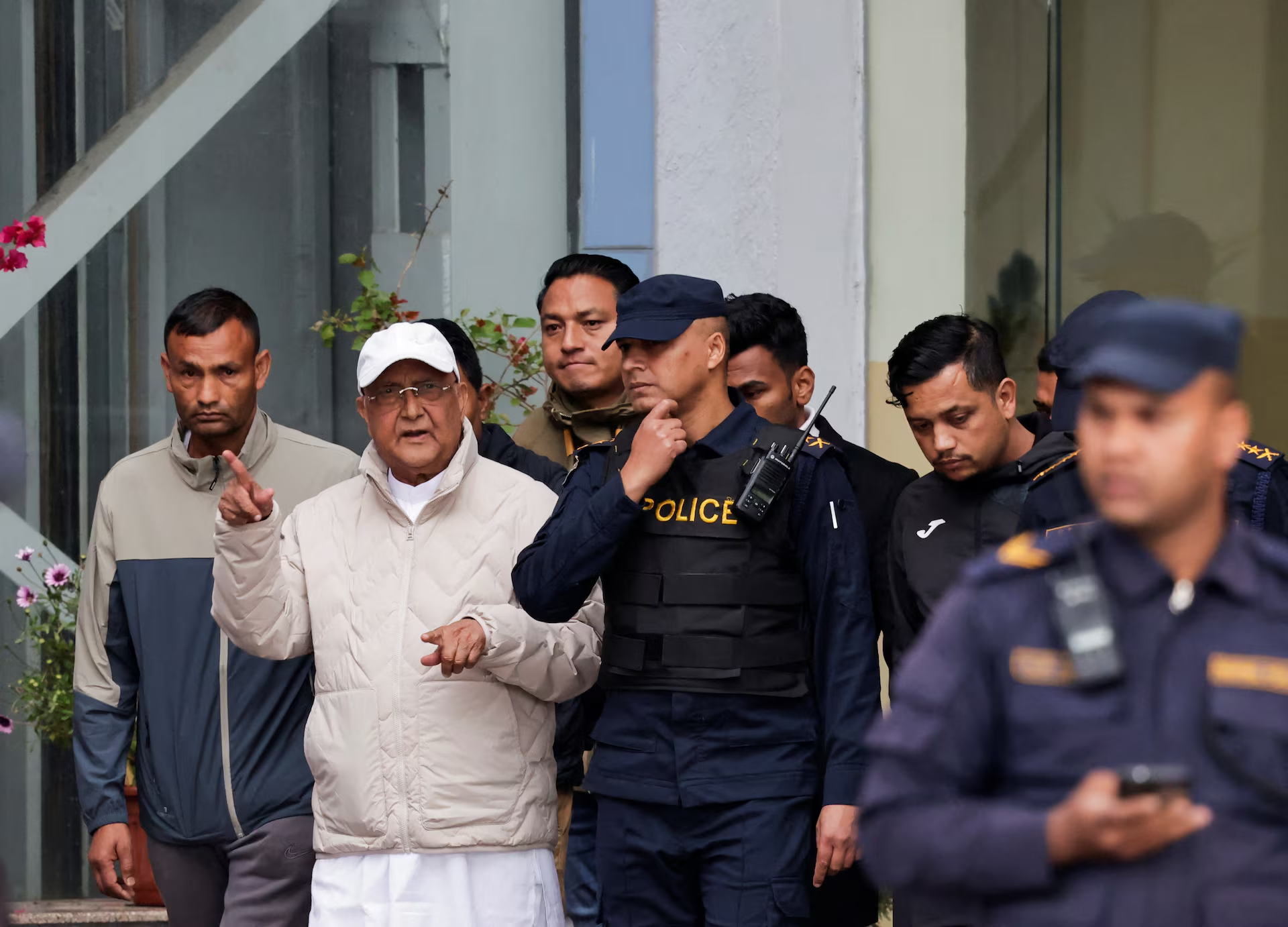
In March 2026, Nepali authorities detained former Prime Minister KP Sharma Oli in connection with the deaths of protesters during “Gen Z-led” demonstrations throughout late 2025 and early 2026. What began as a localized movement against systemic corruption and economic mismanagement evolved into a national demand for justice following a violent crackdown by state security forces. Consequently, Oli’s detention represents a collapse of the traditional impunity enjoyed by Nepal’s political elite and suggests that the balance of power in Kathmandu has shifted from closed-door party agreements to digitally organized street movements. This crisis indicates that legitimacy in modern Nepal is no longer inherited through factional pacts but must be validated by a hyper-connected youth demographic that no longer fears the state apparatus.
Origins and the “Great Disconnect” of the Post-Monarchy Generation
Originally, Nepal’s political landscape was dominated by a cyclical rotation of veteran leaders from the civil war era, who maintained control through deep-seated patronage networks. However, the origin of Oli’s downfall lies in the “Great Disconnect” between this aging gerontocracy and the aspirations of a generation born after the 2008 abolition of the monarchy. As protests intensified over high unemployment and inflation exacerbated by the ongoing war in Iran, the Oli government responded with disproportionate force, failing to anticipate the protesters’ ability to document abuses in real-time. Furthermore, the report emphasizes that the use of live ammunition against students served as the catalyst that unified a fractured opposition and compelled judicial institutions to act against the former head of state.
Structure of Judicial Accountability and Institutional Friction
The structure of the case against Oli is organized around charges of “criminal negligence” and the “authorization of lethal force” against unarmed civilians. Specifically, prosecutors are utilizing internal communication logs and testimonies from high-ranking police officials who allege they received direct orders from the Prime Minister’s Office to “disperse the crowds at any cost.” Moreover, the article highlights the “institutional friction” between the national army, which remained neutral during the unrest, and the police force, which is now facing a top-down purge of its command structure. This restructuring creates a domestic environment where Nepal’s judiciary, historically susceptible to executive pressure, is attempting to assert its independence under the close observation of international human rights organizations.
Democratic Fragility and the Future of South Asia
The successful maintenance of stability in Nepal now faces a paradox where the arrest of a leader as influential as Oli could either pacify the public or, conversely, trigger a violent backlash from his loyalist base in rural strongholds. This objective is essential to understand because it signals that Nepal has entered a “transitional justice” phase that will determine if the country can consolidate its democracy or if it will fall into a cycle of political vendettas. Simultaneously, there is a clear intent among neighboring powers—India and China—to influence the formation of the new interim government to ensure that Nepal does not become a permanent vacuum of regional instability. Ultimately, the Reuters report provides a stable warning: the arrest of KP Sharma Oli is a reminder that in the 21st century, even the most entrenched leaders are no longer immune to the judgment of a generation that refuses to accept silence as a policy.
Reference
Reuters. (2026, March 28). Nepal’s ex-PM Oli held over deaths during Gen Z protests. Reuters Asia-Pacific News. https://www.reuters.com/world/asia-pacific/nepals-ex-pm-oli-held-over-deaths-during-gen-z-protests-2026-03-28/