
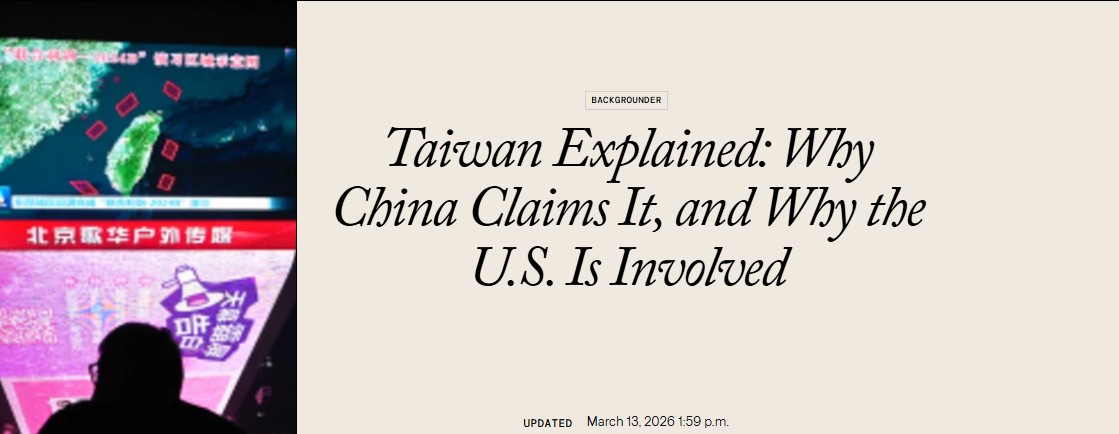
Council on Foreign Relations. Taiwan Explained: Why China Claims It, and Why the U.S. Is Involved
The backgrounder Taiwan Explained: Why China Claims It, and Why the U.S. Is Involved examines the historical, political, and strategic factors shaping the Taiwan issue and its central role in U.S.-China relations.
The analysis focuses on China’s territorial claims, Taiwan’s political status, and the evolving role of the United States, highlighting why the island represents one of the most sensitive geopolitical flashpoints today.
Historical and political roots of the Taiwan issue
The Taiwan issue originates from the Chinese civil war, when the Nationalist government retreated to the island in 1949 after losing control of mainland China. Since then, Beijing has maintained that Taiwan is a breakaway province that must eventually be reunified with the mainland, by force if necessary.
In contrast, Taiwan operates as a self-governing democracy with its own political system. Internal divisions persist, however, as political parties differ on whether to pursue closer ties with China or maintain a distinct identity.
Rising tensions and military risks
Tensions across the Taiwan Strait have increased significantly in recent years. China has expanded military exercises and gray-zone tactics, including cyberattacks and economic pressure, to weaken Taiwan’s position.
At the same time, analysts warn that a potential conflict could involve the United States. While China has not ruled out the use of force, the United States has also not ruled out defending Taiwan, creating a situation of strategic uncertainty.
Although the timing of a possible invasion remains debated, China’s military modernization continues to prioritize a Taiwan contingency, raising concerns about long-term regional stability.
The role of the United States
The United States does not formally recognize Taiwan as an independent country but maintains a strong unofficial relationship through the Taiwan Relations Act. This framework allows Washington to provide military support and maintain the capacity to assist Taiwan in case of conflict.
U.S. policy is guided by strategic ambiguity, meaning it does not clearly state whether it would intervene militarily. However, arms sales and political engagement have increased over time, reinforcing Taiwan’s defensive capabilities.
Recent policy shifts, including tariffs and expanded military cooperation, reflect both economic and security considerations in U.S. strategy toward the region.
Economic importance and global implications
Taiwan’s global importance is closely tied to its semiconductor industry. The island produces more than 90 percent of the world’s most advanced chips, making it a critical component of global supply chains.
This technological role increases the stakes of any potential conflict. Disruptions in Taiwan would have significant consequences for global industries, including electronics, defense, and artificial intelligence.
At the same time, Taiwan’s economic ties with both China and the United States illustrate the complexity of the issue, combining interdependence with geopolitical rivalry.
Reference
Sacks, D., Maizland, L., & Fong, C. (2026). Taiwan explained: Why China claims it, and why the U.S. is involved. Council on Foreign Relations. https://www.cfr.org/backgrounders/china-taiwan-relations-tension-us-policy-trump