
From Security Assurance to Strategic Anxiety
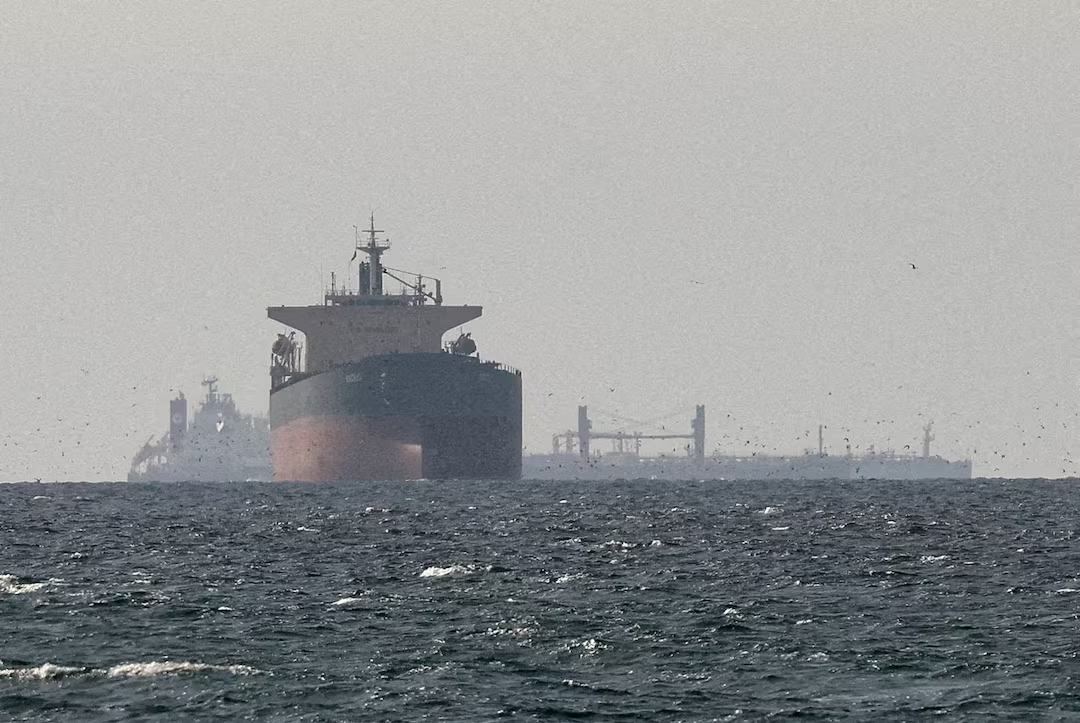
By late April 2026, the diplomatic climate in the Persian Gulf has transitioned from a demand for American protection to a deep-seated anxiety regarding the potential terms of a US-Iran settlement. The Reuters report highlights that Gulf monarchies are increasingly worried that the “Open-for-Open” negotiations currently underway may inadvertently cement Iran’s long-term control over the Strait of Hormuz. Consequently, the focus has shifted from the immediate cessation of hostilities to the permanent geopolitical consequences of a deal that grants Iran de facto regulatory authority over global shipping in exchange for a temporary pause in regional aggression. This suggests that the Gulf Cooperation Council (GCC) states perceive a shift in US priorities toward an “exit strategy” that may leave their primary trade artery under permanent Iranian oversight.
Origins and the “Strategic Abandonment” Narrative
Originally, the Gulf states supported the US-led blockade as a means to degrade Iran’s military capabilities and secure the maritime corridor. However, the origin of the current “Gulf Worry” lies in the perceived American exhaustion and the pressure of domestic energy prices in an election year. For 2026, this has birthed a narrative of strategic abandonment, where regional allies fear the US is willing to accept a “Cold Peace” that recognizes Iran as the primary maritime hegemon in the Strait. The report emphasizes that if the proposed deal allows Iran to inspect or “verify” commercial transit as part of the security arrangements, it would represent a historic concession that turns a temporary wartime position into a permanent “Golden Grip” on the global energy supply.
The Structure of the Regional Hedge
The structure of this diplomatic crisis is organized around three layers of strategic and economic friction. First is the “Dual-Track” hedge, where GCC states are simultaneously protesting the US-Iran talks while secretly opening their own direct communication channels with Tehran to secure bilateral safety guarantees. Second is the credibility gap, as the report notes that the failure of US-led naval coalitions to stop the initial blockade has severely undermined the “Carter Doctrine” in the eyes of regional capitals. Finally, the article highlights the institutional friction between the G7, which demands lower oil prices at any cost, and the Gulf nations, which fear that a hasty deal will trade short-term economic relief for long-term regional instability and Iranian dominance.
Synthesis of the Hegemonic Shift and the New Maritime Order
The successful negotiation of a maritime deal now faces a paradox where the “restoration of trade” may facilitate a fundamental shift in the regional balance of power. This represents the “hegemonic transition” dilemma in political science, where the withdrawal or compromise of a global superpower creates a vacuum that is filled by a local challenger. There is a clear intent in the Reuters analysis to show that for the Gulf states, the “Golden Grip” of Tehran is a more significant long-term threat than the war itself. Ultimately, it is clear that for 2026, the Strait of Hormuz has become more than a shipping lane; it is the physical manifestation of a new maritime order where the rules are increasingly written in Tehran rather than Washington.
Reference
Reuters. (2026, April 20). Gulf worries US-Iran talks may cement Tehran’s “golden grip” on Hormuz. Reuters Energy & Geopolitics. https://www.reuters.com/business/energy/gulf-worries-us-iran-talks-may-cement-tehrans-golden-grip-hormuz-2026-04-20/