
China’s Semiconductor Challenge
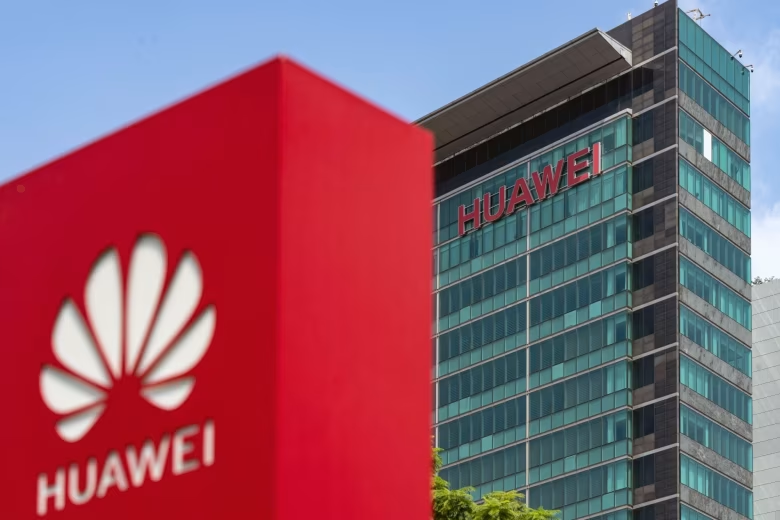
China’s semiconductor ambitions are facing major technological and geopolitical barriers. According to The Wall Street Journal, Huawei and other Chinese technology firms continue to push for greater chip self-sufficiency, but their progress remains limited by export controls and restricted access to advanced manufacturing tools. This issue is central to the broader technological rivalry between China and the United States.
The Importance of Advanced Chipmaking Tools
A key obstacle for China is limited access to extreme ultraviolet lithography machines, known as EUV tools. These machines, produced by Dutch company ASML, are essential for manufacturing the most advanced semiconductors. Because China has been restricted from obtaining them, Chinese firms must rely on older production methods and alternative technical strategies to improve performance.
Huawei’s Workaround Strategy
The article explains that Huawei has promoted a concept known as “Tau Law” as a possible alternative to Moore’s Law. However, the report suggests that this is more of a workaround than a true breakthrough. Instead of producing cutting-edge chips through the most advanced manufacturing processes, Huawei’s approach relies on combining or stacking older technology to improve chip performance. This may help China reduce some dependence on foreign suppliers, but it does not fully close the technological gap.
Export Controls and Technology Competition
U.S.-led export controls have slowed China’s access to advanced semiconductor equipment, although loopholes and indirect supply routes remain a concern. The semiconductor sector has become one of the most important fronts in U.S.–China strategic competition because advanced chips are essential for artificial intelligence, defense systems, data centers and high-end electronics. As a result, chip production is no longer only an industrial issue, but also a national security priority.
International Relevance
Overall, the WSJ report shows that China’s path toward semiconductor self-sufficiency remains difficult. While Beijing and Chinese firms continue to invest heavily in domestic innovation, the lack of access to critical global technologies limits their ability to compete at the cutting edge. For this reason, China’s chip ambitions matter internationally: they reflect how export controls, supply chains and technological dependence are reshaping the global economy and the balance of power in advanced technology.
Reference: The Wall Street Journal. (2026, June 2). China’s chip ambitions run into a global tech wall. https://www.wsj.com/world/china/chinas-chip-ambitions-run-into-a-global-tech-wall-669a1835