

Achieving financial security has become increasingly difficult for millions of working families across the United States. In this comprehensive review, we examine the systemic research published by the Brookings Institution.
The multi-part series, titled “States of Affordability,” provides an in-depth look at regional economic pressures. Consequently, we break down the core factors driving the modern US household affordability crisis.
Why Working Families Struggle to Make Ends Meet
The report shifts the economic conversation away from national averages to focus on localized struggles. While macroeconomic indicators like GDP growth might look positive, the daily reality on the ground tells a very different story.
Working-class and middle-income families are finding that basic necessities consume a disproportionate share of their take-home pay. This systemic pressure exists because wages have failed to keep pace with the localized cost of living. As a result of this widening gap, even households with multiple income earners are frequently forced to live paycheck to paycheck.
Visualizing the Crisis: The Average US Household Budget Breakdown
To understand why so many families are struggling, it is essential to look at where their money actually goes. The following chart illustrates the dominant fixed expenses that deplete typical household earnings:
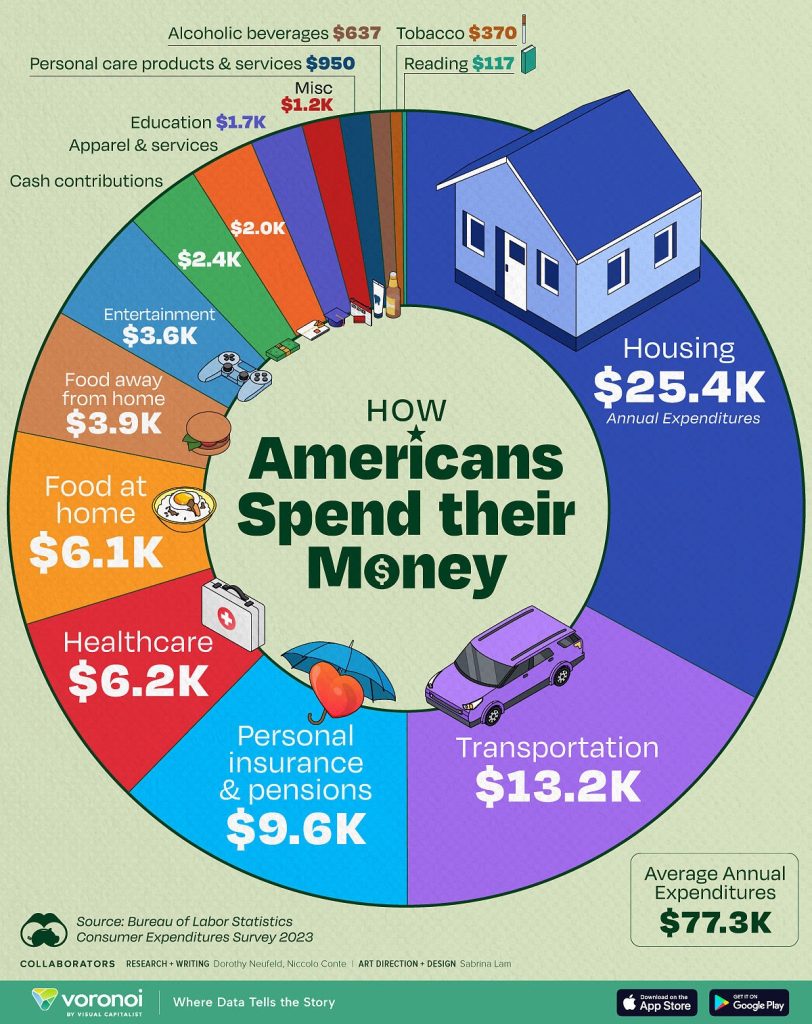
The Brookings research identifies specific structural pillars that act as the primary catalysts for financial instability. These expenses are completely non-discretionary, meaning families cannot simply opt out of paying them to save money.
1.- The Regional Housing Squeeze
Housing stands as the single largest financial burden for most households. Across various states, a severe shortage of affordable units has driven both rent and mortgage rates to historic highs. Therefore, millions of Americans are now classified as “rent-burdened,” spending more than 30% of their gross income just to maintain a roof over their heads.
2.- Escalating Healthcare and Childcare Tolls
In addition to shelter, the rising cost of childcare and medical services creates an insurmountable barrier for upward mobility. In many states, child care costs for two children actually exceed average housing expenses. Because of these overwhelming prices, parents are frequently forced to reduce their working hours or leave the workforce entirely.
| Major Expense Category | Primary Impact on Households | Regional Variability |
| Housing & Rent | Consumes over 30% of average income. | Highest in coastal metros and booming tech hubs. |
| Childcare | Often exceeds the cost of a college tuition. | Varies heavily based on state-level subsidies. |
| Transportation | Essential for employment but highly volatile. | Greatest burden in suburban and rural car-dependent zones. |
A Patchwork Policy Problem
The true academic value of this Brookings study lies in its geographical approach. The researchers successfully demonstrate that the US household affordability crisis is not a uniform issue. Instead, it is a complex economic patchwork.
For instance, a family living in a high-tax northeastern state faces entirely different financial hurdles than a household in the rural South. However, despite these regional variations, the underlying systemic threat remains identical: the baseline cost of basic survival has become far too expensive. Therefore, federal policy solutions must be flexible enough to address these highly specific local bottlenecks.
In conclusion, the Brookings series serves as a vital wake-up call for policymakers and economic analysts alike. True economic health cannot be measured solely by the performance of the stock market. Until structural reforms lower the baseline costs of housing, childcare, and healthcare, the US household affordability crisis will continue to deepen, leaving millions of hardworking citizens behind.
Reference
Brookings Institution. (2026). States of affordability: A series on where and why US households struggle to make ends meet. Brookings. https://www.brookings.edu/articles/states-of-affordability-a-series-on-where-and-why-us-households-struggle-to-make-ends-meet/