
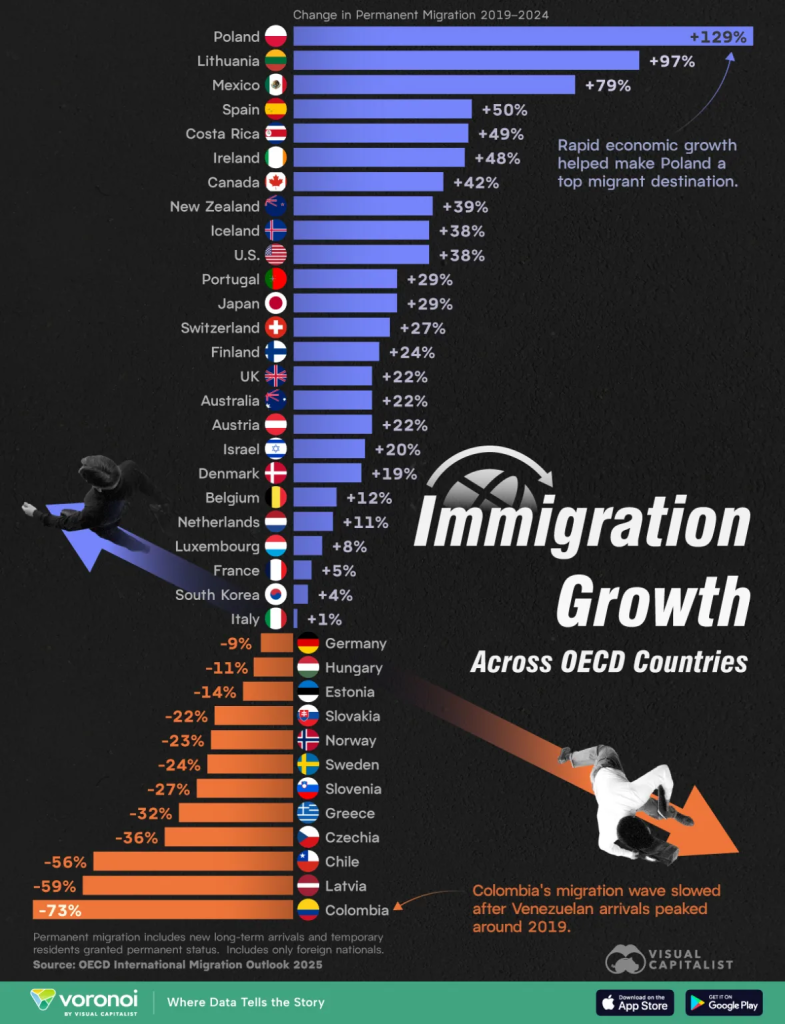
Permanent immigration patterns across OECD countries have undergone a significant transformation between 2019 and 2024. While traditional destinations like the U.S. and Canada remain major hubs, the data reveals that migration growth is broadening toward emerging destination countries.
Top Countries for Immigration Growth
Poland has recorded the most rapid growth in permanent immigration across the OECD, with a 129% increase since 2019. Lithuania follows in second place with a 97% surge. Meanwhile, Mexico has seen a 79% increase. Other notable growth leaders include Spain at 50% and Costa Rica at 49%. Ireland, Canada, New Zealand, Iceland, and the U.S. also recorded significant growth ranging from 38% to 48%. Furthermore, Portugal and Japan each saw a 29% increase, while Switzerland, Finland, and the UK rounded out the top 15 with growth between 22% and 27%.
Key Drivers and Regional Declines
The average immigration growth across the OECD during this period was 13%. Poland’s strong labor market, combined with rising wages and rapid economic expansion, has established it as one of Europe’s fastest-growing destinations for international workers. Conversely, not every nation experienced growth. Colombia recorded a 73% decline, Latvia saw a 59% decrease, and Czechia experienced a 36% drop. Colombia’s decrease is attributed to a stabilization following a peak in arrivals from Venezuela around 2019.
Overall, the data suggests that migration is becoming less concentrated in traditional hubs as workers increasingly respond to shifting labor demands and new economic opportunities.
Visual Capitalist. (2026). Ranked: Countries With the Fastest Immigration Growth (2019–2024). https://www.visualcapitalist.com/ranked-where-immigration-increased-the-most-across-oecd-countries/?mc_cid=03bdd64aaf&mc_eid=68a2fc5428