
A national assessment supports education reform.
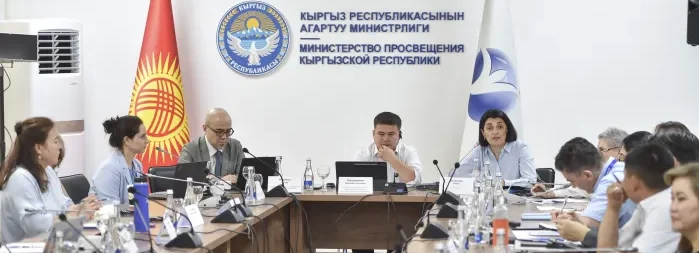
Representatives from the Ministry of Education, district education authorities, schools and development partners met in Bishkek to validate the findings of Kyrgyzstan’s first national assessment of district-level capacity to support teachers and schools. Conducted by UNICEF, IIEP-UNESCO, the UNESCO Almaty Office and Evidence Central Asia, the assessment supports the country’s Altyn Kazyk education reform programme. Moreover, it aims to strengthen district-level leadership as Kyrgyzstan implements a 12-year education system, curriculum modernization and administrative reforms.
Evidence identifies key challenges.
The assessment examined the work of District Education Departments (DEDs) and their methodologists, who provide pedagogical guidance to schools and teachers. However, the study found that these professionals spend much of their time on reporting, administrative duties and compliance tasks rather than direct instructional support. As a result, many teachers experience district-level engagement as supervision instead of continuous professional assistance, revealing a gap between official responsibilities and daily practice.
A roadmap for stronger district support.
During the three-day workshop, participants transformed the study’s findings into a roadmap for future reforms. Specifically, the roadmap focuses on five priorities: expanding pedagogical support to all schools, strengthening professional development for methodologists, clarifying institutional responsibilities, improving the use of data and digital tools, and promoting a culture that prioritizes teacher support over administrative control. Furthermore, the findings will guide the creation of Territorial Education Development Centres and provide a baseline for future investments.
IIEP-UNESCO reinforces evidence-based policymaking.
IIEP-UNESCO supported the assessment by leading the research design, data collection, analysis and quality assurance of the study. In addition, the organization worked closely with the Ministry of Education to ensure that the recommendations aligned with national reform priorities. Drawing on experience from countries such as Pakistan, Guyana and Kenya, IIEP also connected Kyrgyzstan’s reforms with international evidence on strengthening district-level education leadership to improve teaching and learning outcomes.
Reference
United Nations Educational, Scientific and Cultural Organization. (2026, July 2). Kyrgyzstan advances education reforms by strengthening district-level support for schools and teachers. International Institute for Educational Planning UNESCO. https://www.iiep.unesco.org/en/articles/kyrgyzstan-advances-education-reforms-strengthening-district-level-support-schools-and-teachers