
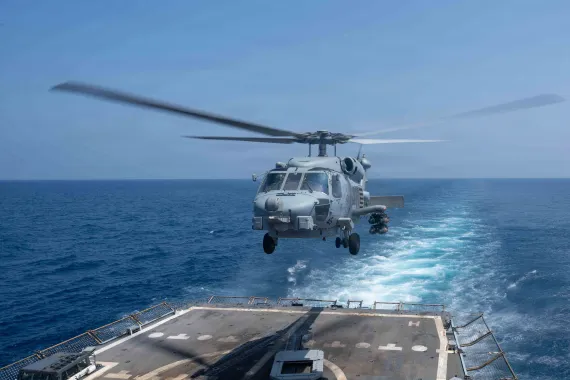
As regional security frameworks collapse, the sharp US Iran military conflict escalation has reached a critical flashpoint. U.S. Central Command (CENTCOM) confirmed it has executed its seventh consecutive night of intense aerial and naval bombardment against Iranian infrastructure. With civilian transport hubs heavily damaged and retaliatory strikes hitting American installations across four neighboring nations, the risk of full-scale war has hit unprecedented levels.
CENTCOM Targets Vital Coastline Infrastructure
To understand the rapidly growing scope of this operation, observers must analyze the specific geographic targets chosen by Western planners. The latest bombardment utilized a combination of carrier-based fighter aircraft, guided-missile warships, and long-range aerial drones. These forces focused heavily on the vital southern coastline of Iran bordering the strategic Strait of Hormuz.
According to local reports from Hormozgan province, targeted precision strikes successfully neutralized multiple logistics bases, maritime patrol networks, and underground weapons depots.
However, the operational focus has rapidly expanded beyond purely military installations. Severe structural damage has been reported along the Bandar Abbas-Rudan transportation corridor, where multiple bridges were completely destroyed. Consequently, this US Iran military conflict escalation is creating immense friction for civilian logistics and internal supply chains.
Multi-National Retaliation Hits U.S. Bases
True to their warnings, Iranian forces did not allow these actions to pass without an immediate counter-response. The Islamic Revolutionary Guard Corps (IRGC) deployed waves of ballistic missiles and explosive drones across the region. These counter-strikes intentionally targeted American military personnel stationed in allied neighboring countries.
Explosions were confirmed near the Muwaffaq Salti Air Base in Jordan, alongside air defense activations in Kuwait and Qatar. Falling missile debris reportedly caused injuries to civilians in downtown Doha. As a result, the conflict is no longer a localized border dispute, but a highly coordinated regional confrontation.
The Total Collapse of the Peace Memorandum
For international commerce and global shipping lines, this ongoing warfare introduces massive financial and physical risks. The maritime blockade re-established in the Strait of Hormuz has brought container traffic to a complete halt. Commercial shipping lines are completely refusing to enter the waterway due to the high risk of naval mines.
Furthermore, this violence marks the complete breakdown of the Islamabad Memorandum signed just last month. Diplomatic channels have frozen entirely as both sides prioritize kinetic military dominance over compromise. Businesses worldwide must now prepare for a prolonged period of extreme volatility in international energy markets.
A Highly Unpredictable Security Outlook
Restoring diplomatic balance will become increasingly difficult as casualties mount on both sides. The structural defense lines broken over the past seven days have established a dangerous new baseline for Middle Eastern geopolitics.
Moving forward, international stakeholders must adjust to a fragmented security landscape. Traditional maritime rules of engagement no longer apply in these highly contested waters. Ultimately, the immediate challenge for global leadership is preventing this intense week of strikes from transforming into a permanent continental war.
Sabah, Z., Angopa, B., & Rowlands, L. (2026, July 18). Iran war live: US and Iran exchange attacks for 7th consecutive night. Al Jazeera. https://www.aljazeera.com/news/liveblog/2026/7/18/iran-war-live-us-and-iran-exchange-attacks-for-7th-consecutive-night