
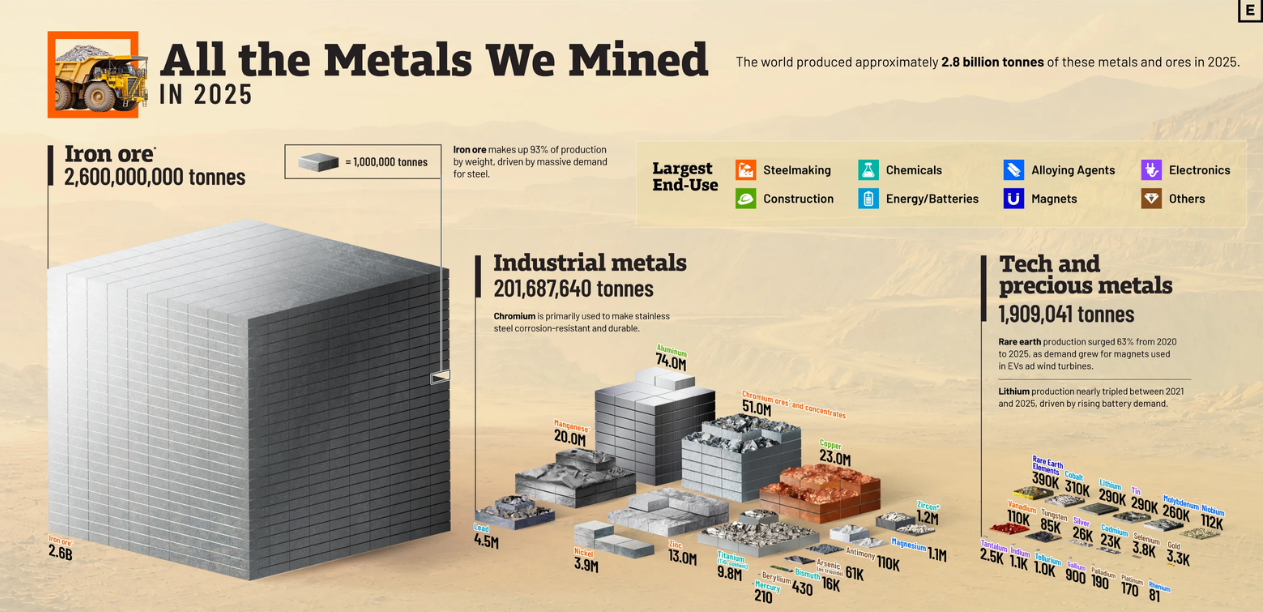
Bruno Venditti’s article compares estimated 2025 production across 35 metal-related commodities using data from the U.S. Geological Survey’s Mineral Commodity Summaries 2026. Its central finding is the enormous difference between materials supporting infrastructure and those enabling advanced technologies.
Together, the selected commodities represent approximately 2.80 billion tonnes of reported production. However, these figures combine different stages of extraction and processing. Therefore, the total should not be interpreted as a uniform measure of mined metal content.
Iron Ore and Industrial Materials
Iron ore dominates the comparison at an estimated 2.6 billion tonnes, accounting for approximately 93% of the combined reported weight. This reflects the scale of steelmaking and its role in buildings, bridges, vehicles, machinery and railways.
Meanwhile, primary aluminum follows at 74 million tonnes. Chromite ores and concentrates reach 51 million tonnes, while copper totals 23 million tonnes. These materials support applications ranging from lightweight construction and electrical transmission to stainless steel production. Consequently, their volumes illustrate the substantial material demands of physical infrastructure.
Battery Metals and Rare Earths
In contrast, much smaller production volumes support rapidly expanding technology industries. For example, lithium output reached approximately 290,000 tonnes in 2025, compared with 82,500 tonnes in 2020. Production thus more than tripled as rechargeable battery demand grew.
Similarly, rare earth production reached an estimated 390,000 tonnes of oxide equivalent, around 39% above its 2021 level. Neodymium and praseodymium support magnets used in electric motors and wind turbines.
Additionally, cobalt serves certain battery chemistries, with output reaching 310,000 tonnes. Gallium, indium and tantalum also contribute to specialized electronic applications.
Production Weight and Economic Importance
Nevertheless, production weight alone does not determine economic or strategic importance. Gold output was approximately 3,300 tonnes, far below copper’s volume. Yet scarcity and demand for jewelry, investment and technology sustain its value.
Likewise, platinum and palladium were produced at only about 170 and 190 tonnes, respectively. Despite these small volumes, both remain important to catalytic converters and industrial processes.
Therefore, a material’s limited share of global output does not necessarily imply limited significance. Tonnage alone cannot establish market value, substitutability or importance to a particular technology.
Methodological Limits and Overall Assessment
The piece’s main strength is its accessible explanation of production scale alongside clear methodological qualifications. Specifically, iron ore and chromite figures describe ore or concentrate weight, whereas copper, nickel and lithium figures measure contained metal. Aluminum and magnesium, meanwhile, reflect smelter output.
Furthermore, some estimates exclude withheld U.S. production or omit certain producing countries. Several metals also emerge as byproducts of other operations.
These distinctions limit direct comparisons but strengthen the article’s transparency. Overall, the piece offers a useful introduction to the global economy’s material foundations while demonstrating why production statistics require careful interpretation.
Reference
Venditti, B. (2026, October 29). All the metals the world mines in a year, visualized. Visual Capitalist.