
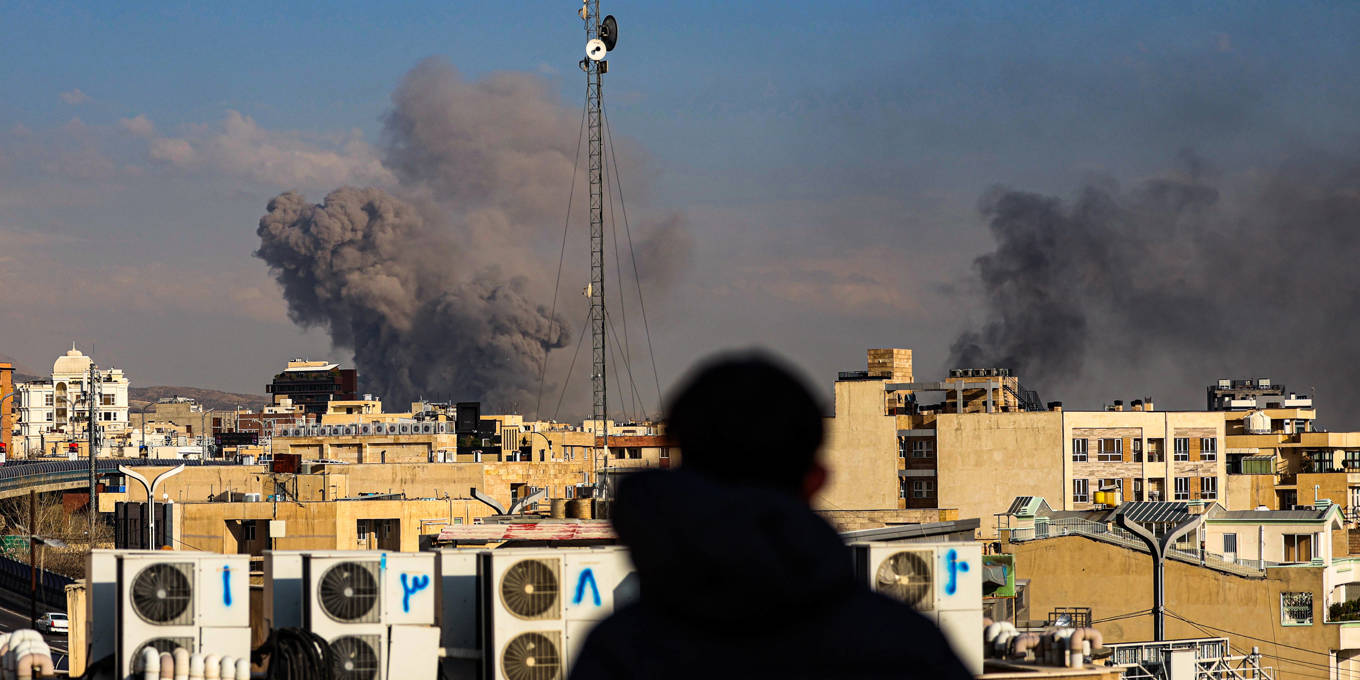
Escalation in the Middle East
After joint US-Israeli strikes killed Ali Khamenei, Iran retaliated across the region, raising fears of a prolonged and destabilizing conflict.
Meanwhile, Washington signaled operations could last weeks or longer, intensifying uncertainty throughout the Middle East.
A War of Choice
According to Richard Hass, Iran posed no imminent threat warranting preventive war under international norms.
Furthermore, diplomacy and economic pressure remain available alternatives to military escalation.
However, regime change requires ground presence, making airpower alone insufficient for durable political transformation.
Consequently, the United States risks entrapment in a conflict whose scale and duration Iran can influence.
The Dangers of State Collapse
Stephen Holmes warns that destroying centralized regimes often produces fragmentation rather than stability.
Similarly, precedents in Iraq and Libya demonstrate how power vacuums enable arms proliferation and extremist resurgence.
In Iran’s case, dispersed nuclear material could amplify proliferation risks beyond conventional weapons leakage.
Therefore, eliminating state custodianship may undermine deterrence and complicate future verification or negotiation.
Authoritarian Incentives and Corruption
Timothy Snyder argues that foreign war can consolidate domestic authority and deflect political pressure.
At the same time, he highlights financial ties between Gulf monarchies and President Trump’s family interests.
Thus, militarized policy may intertwine authoritarian ambition with personal enrichment.
Moreover, war can expose leaders’ motives rather than conceal them.
Eroding Institutional Constraints
For Daron Acemouglu, the attack reflects a broader effort to remove institutional limits on executive power.
In parallel, the administration designated Anthropic a supply-chain after it sought safeguards against surveillance misuse.
Consequently, state power appears deployed to intimidate private actors and normalize rule-breaking behavior.
Hence, domestic institutions may weaken alongside international norms.
National Security and Domestic Blowback
Aziz Huq cautions that expansive national-security claims abroad can migrate into domestic governance.
Notably, reported plans for executive control over election procedures raise constitutional concerns.
Therefore, unchecked foreign-policy authority could embolden further assertions of unilateral presidential power.
Khamenei’s Institutional Legacy
Pegah Benihashemi explains that Iran’s constitution concentrates authority in interconnected institutions.
Under Khamenei, the Revolutionary Guard evolved into a political and economic powerhouse reinforcing centralized rules.
Accordingly, leadership decapitation alone is unlikely to dismantle entrenched authoritarian structures.
Ultimately, meaningful change depends on reforming the institutional architecture sustaining concentrated power.
Source:
Project Syndicate. (2026, March 3). America’s latest Middle-East fiasco. Project Syndicate. https://www.project-syndicate.org/onpoint/america-s-latest-middle-east-fiasco