
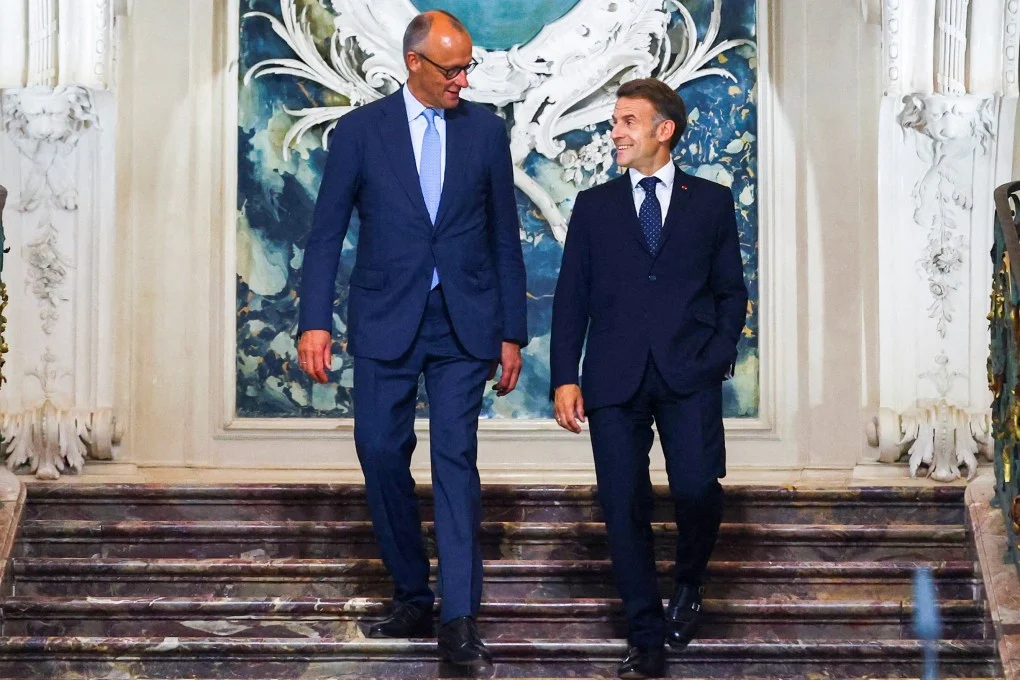
As the EU China trade deficit widens to historic levels, Europe’s two largest economies are aligning to push for aggressive trade defense measures. Following the Franco-German Ministerial Council, German Chancellor Friedrich Merz and French President Emmanuel Macron demonstrated a unified strategy against Beijing’s expanding export presence. This shift marks a major realignment in Berlin’s approach, bringing German industrial strategy into closer alignment with France’s long-standing protectionist stance.
For years, French and German leaders held contrasting views on trade policies toward Beijing. However, as local industrial bases face pressure from cheaper foreign imports, Germany has adopted a firmer position.
“Our work between Germany and France is indispensable at a time when Russia threatens our security, when the People’s Republic of China challenges our economy, and when the transatlantic partnership has lost its self-evident character,” declared German Chancellor Friedrich Merz.
While French President Emmanuel Macron openly criticized China’s aggressive commercial strategy, both leaders agreed that current market conditions require immediate policy action. Consequently, as the EU China trade deficit widens, both nations are calling on the European Commission to present concrete proposals that enhance the bloc’s trade defense toolbox and protect domestic manufacturing sectors.
Pushing Brussels for Concrete Economic Security Frameworks
This unified Franco-German position places direct pressure on Brussels to accelerate economic security measures. The two nations are preparing a joint road map to outline specific regulatory priorities ahead of upcoming European Union legislative sessions.
Key priorities established in the joint statement include:
- Systematic Enforcement: Maximizing the application of existing anti-subsidy and anti-dumping mechanisms across European markets.
- Industrial Policy Integration: Aligning national subsidies to support key domestic supply chains against foreign competitors.
- Trade Defense Expansion: Urging Brussels to introduce updated regulations targeting market distortions.
Business and Compliance Considerations for Global Supply Chains
For multinational corporations, compliance directors, and cross-border logistics planners, this regulatory alignment signals a tighter trade environment across European markets. Companies operating within European supply chains must prepare for increased scrutiny regarding imported components and raw materials.
Furthermore, businesses relying on cross-border manufacturing should audit their exposure to potential tariff adjustments and trade defense investigations. Proactively diversifying supply networks and ensuring strict compliance with European trade regulations will remain essential to mitigate operational disruptions as new defense frameworks take effect.
A Decisive Era for European Commercial Policy
Rebalancing European trade relationships requires sustained coordination between member states and European Union institutions. Traditional, fragmented national policies are no longer sufficient to address modern global market dynamics.
Moving forward, the success of Europe’s economic strategy will depend on how swiftly Brussels translates this Franco-German alignment into enforceable policies. As global competition intensifies, establishing clear, resilient trade frameworks will be vital to safeguarding the bloc’s long-term industrial competitiveness.
Xu, X., & Huang, H. (2026, July 20). As EU’s China trade deficit widens, Germany changes tack to join France’s Beijing pushback. South China Morning Post. https://www.scmp.com/economy/china-economy/article/3361187/eus-china-trade-deficit-widens-germany-changes-tack-join-frances-beijing-pushback