
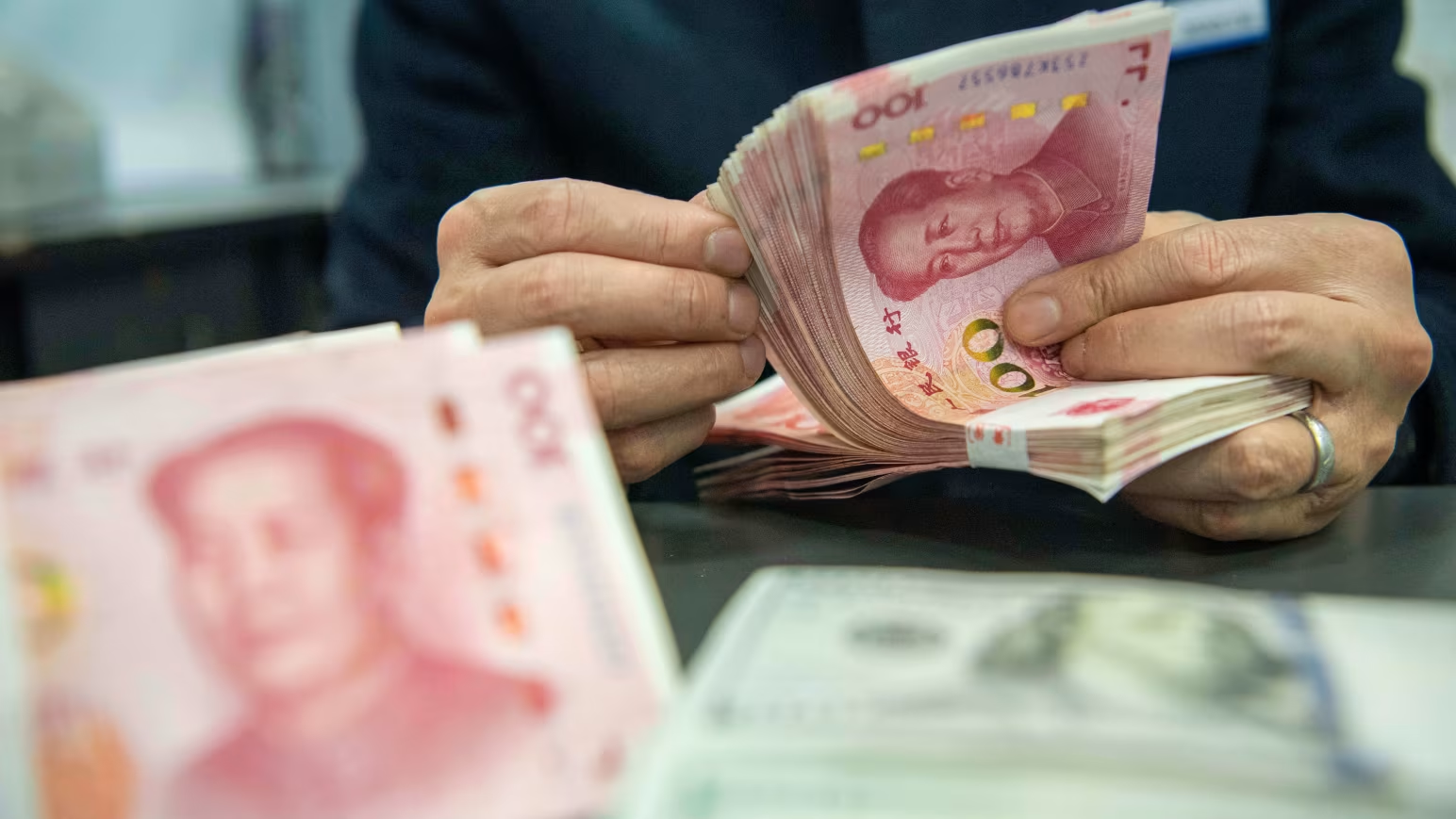
China is moving to capitalize on growing uncertainty in global markets to challenge the dominance of the US dollar and expand its international influence. Recent volatility, driven largely by Trump’s unpredictable economic policies, has weakened confidence in the dollar, which has fallen to four-year lows, while gold prices have surged. Against this backdrop, Beijing is presenting the renminbi as a credible alternative in global finance. Remarks from President Xi Jinping, published by the Communist Party’s flagship journal, outline ambitions to turn the renminbi into a global reserve currency. Even when few expect it to displace the dollar in the near future.
Why does China’s plan matter now?

China’s leader Xi Jinping speaks next to France’s President Emmanuel Macron (unseen) during a joint press conference at the Great Hall of the People in Beijing, China on December 3, 2025.
Adek Berry/Pool/Getty Images
China has long worked to internationalize the renminbi, but current conditions have made that effort more promising. Trade tensions, repeated US tariffs, and uncertainty over American monetary policy have fueled a broader trend of “de-dollarization”. Prompting investors and governments to reconsider their reliance on the dollar. Leadership uncertainty at the Federal Reserve and calls from European leaders to elevate the euro’s role have reinforced this shift. Analysts argue that Beijing sees this moment as a rare opening, as dissatisfaction with the dollar grows and countries seek hedges against US financial power.
Why control a global reserve currency?
Holding a global reserve currency brings immense economic and political advantages. The dollar’s central role since World War II has allowed the US to borrow cheaply, shape global financial rules, and impose sanctions with broad reach. China wants to reduce its vulnerability to this system while increasing its own influence. Although the IMF recognizes several reserve currencies, the renminbi’s role remains small. Expanding its use would help China shield itself from US pressure and gain greater leverage in global trade and finance.
What has China done to bolster the renminbi?

A citizen walks past the headquarters of the People’s Bank of China (PBC), the central bank of China in Beijing, China, on May 20, 2025.
Jiang Qiming/China News Service/VCG/AP
Beijing has taken steps to make the renminbi more attractive, including opening access to Chinese financial markets, improving cross-border payment systems, and promoting its use in trade settlements. Stronger economic ties with developing countries have also increased renminbi usage, particularly after Western sanctions on Russia pushed Moscow to rely more heavily on China. Chinese officials have framed this as part of a broader push toward a multipolar currency system, reducing dependence on the dollar.
Could the renminbi really replace the dollar?
Despite China’s ambitions, the renminbi remains far from replacing the dollar. The US currency still dominates global reserves, while the renminbi accounts for only a small share. Capital controls, limited financial transparency, and China’s preference for keeping its currency relatively weak to support exports all constrain its appeal. Experts widely agree that Beijing does not expect full replacement but sees an opportunity to gain incremental ground as global financial and geopolitical conditions shift.
Reference
Yang, S. (2026, February 3). China reveals its plan to challenge the US dollar for dominance. Could it ever work? CNN. https://edition.cnn.com/2026/02/03/money/china-dollar-currency-challenge-hnk-intl