
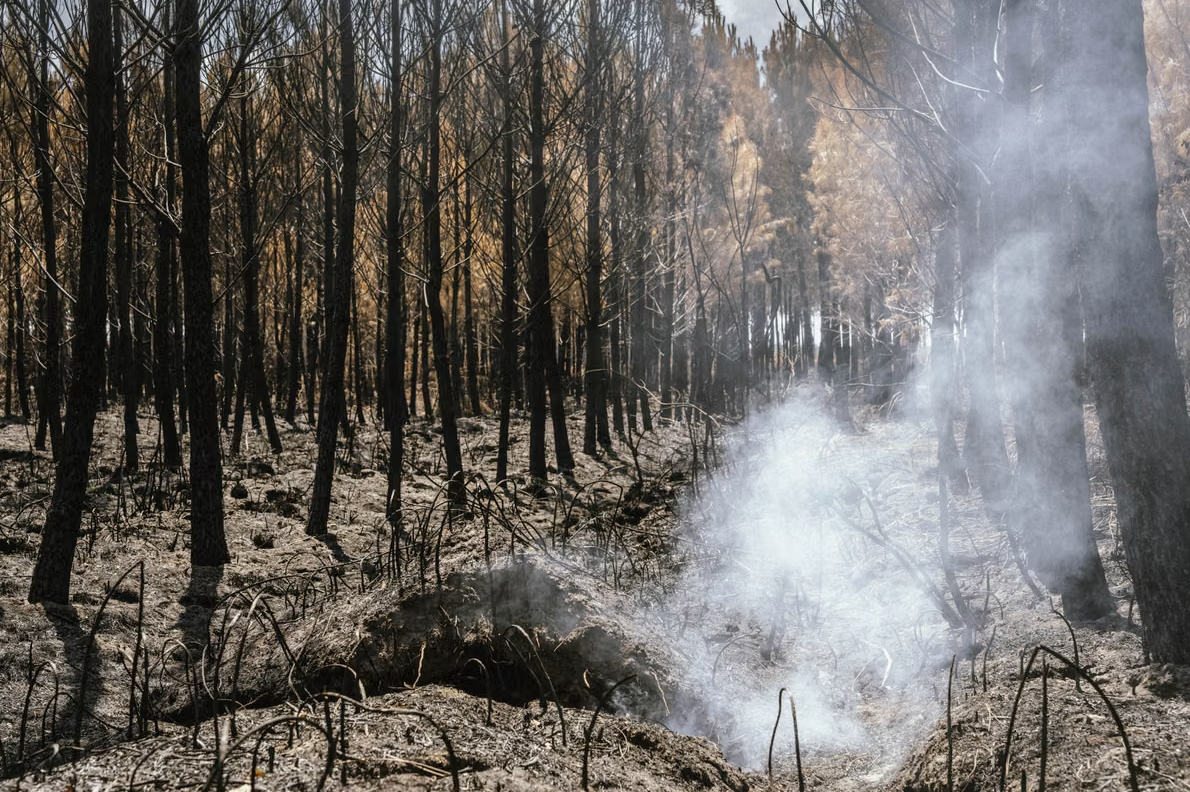
France’s wildfires this year have released over 1.5 million tonnes of carbon, according to Copernicus. That is nearly four times the annual average since 2003. It is the highest ever recorded. More than 96,000 hectares have burned, compared to 14,000 hectares on average.
The fires pose a major challenge. France must cut emissions to meet climate goals. But its forests are losing their ability to absorb carbon. Warming makes fires more intense and frequent. The risk is spreading across the country.
Measuring fire emissions is tricky. Satellites estimate above-ground vegetation, but biomass varies. Litter stores about one-third of forest carbon. In the Landes region, pine needle layers can be several centimetres thick.
Copernicus data may underestimate emissions. A researcher said the system has biases. It uses global models with generic values. But it is the best available at large scale. A 2025 study found emissions from France’s 2022 fires were actually twice as high.
Using local data, a researcher estimates the Landes fire alone released at least 2.4 million tonnes of carbon. That is equivalent to the annual emissions of over 1 million people. A French person emits about 2.2 tonnes per year. In 2022, fires accounted for nearly 2 percent of France’s total emissions. They also cut forest carbon absorption by 30 percent.
Reference
Le Monde, “Les incendies de l’été 2026 en France sont responsables d’émissions de carbone d’une ampleur inédite,” published September 1, 2026. https://www.lemonde.fr/planete/article/2026/09/01/les-incendies-de-l-ete-2026-en-france-sont-responsables-d-emissions-de-carbone-d-une-ampleur-inedite_6763477_3244.html