
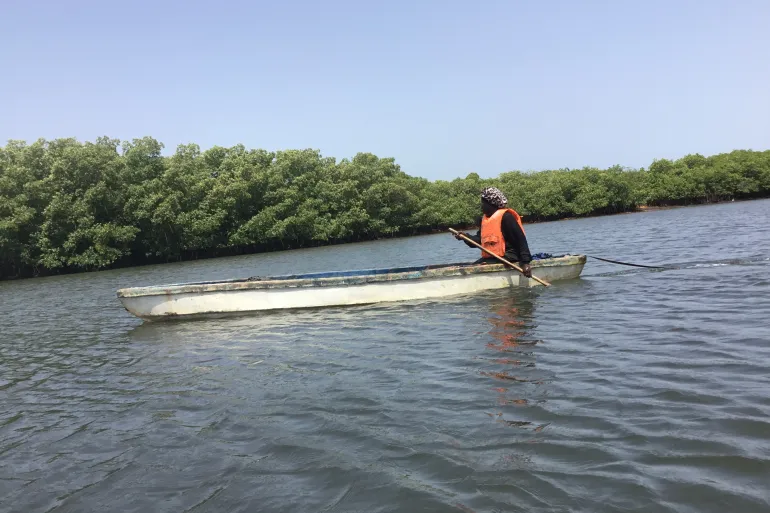
In low-lying coastal areas near The Gambia’s capital city of Banjul, local women harvesters have taken on a central role in restoring and protecting the surrounding Tanbi Wetland mangrove ecosystem. Historically relying on the forest for oyster harvesting, crab collection, and fishing to support their household incomes.
In short, these women now actively plant thousands of mangrove seedlings to reverse ecological degradation. Their work is integrated with sustainable community management practices, such as observing seasonal harvesting bans during the rainy season. In order to allow shellfish populations time to naturally regenerate and mature.
Beyond economic survival, the environmental restoration serves a critical structural defense function for the low-lying island city, Which are up against severe climate threats, including sea-level rise, coastal erosion, and violent flooding events. The deep, interconnected root systems of the mangroves act as a natural barrier that stabilizes shorelines and buffers urban infrastructure.
While local harvesters continue to navigate operational challenges such as a lack of cold-storage infrastructure to preserve their catches. There has been targeted conservation training has equipped them to manage and safeguard the wetland effectively over the long term.
In conclusion, the community-led restoration of mangroves by Gambian women demonstrates how local ecological stewardship directly strengthens climate resilience and protects vulnerable urban populations. By balancing economic resource extraction with active ecosystem rehabilitation, these efforts preserve vital livelihoods while maintaining the natural defenses necessary to shield coastal cities from climate-driven destruction.
Reference
Kaddy Jawo. (2026, August 6). How Gambian women are restoring the mangroves protecting Banjul. Al Jazeera. https://www.aljazeera.com/news/2026/8/6/how-gambian-women-are-restoring-the-mangroves-protecting-banjul