
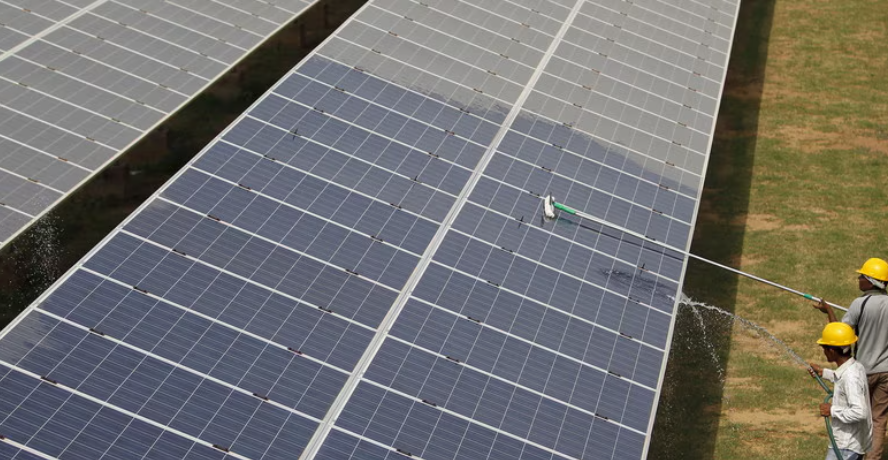
India is undergoing a structural transformation by industrializing on cheap solar power and batteries instead of following the historical fossil-fuel-intensive path taken by countries such as Britain, the United States and China. This trajectory is enabled by a rapid shift in energy economics: where coal once vastly undercut solar, solar plus storage in India now costs roughly half as much as new coal capacity, and batteries are far cheaper than when China expanded its oil-based transport system. As a result, India already generates about 9% of its electricity from solar, uses only a quarter as much coal per capita as China did at a similar income level, and is nearing a peak in coal-fired power generation. In transport, road oil demand per person remains low and electric vehicles are gaining ground, reaching close to 5% of car sales, while electric three-wheelers approach 60% of their market segment. Electricity’s share of final energy stands near 20%, broadly in line with China at equivalent income levels and comparable to advanced economies.
Two main factors underpin this evolution: a more service-oriented, less energy-intensive economy and targeted policies that prioritize clean-energy value chains and electrotech investment. These policies have supported a manufacturing boom, particularly in electronics, whose output has increased nearly sixfold in a decade to about $130 billion, creating capabilities that spill over into solar modules, batteries and electric vehicles. Solar module production has expanded to roughly 120 GW, while cell manufacturing has reached about 18 GW, positioning India for self-sufficiency and export potential. This electrotech strategy strengthens energy sovereignty by reducing dependence on fossil fuel imports, which still amounted to 3.6% of GDP in 2024, and it lowers exposure to price volatility and geopolitical risks. India’s experience demonstrates that the “old model – burn first, clean up later – came at a cost” and that fast, low-carbon industrialization is now viable for emerging economies.
Reference
Bond, K., & Sinha, S. (2026, March 25). How India is charting a new path into the electric age. World Economic Forum. https://www.weforum.org/stories/2026/03/how-india-is-charting-a-new-path-into-the-electric-age/