
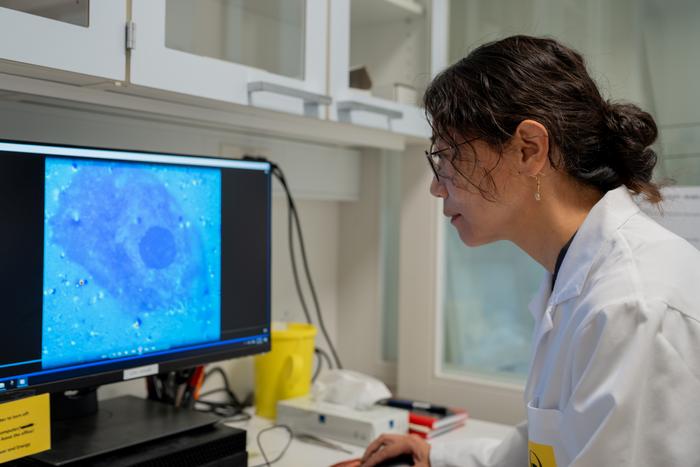
Researchers at Aarhus University have developed light-sensitive nanoparticles that could potentially help damaged retinas respond to light again. The technology is designed for conditions in which photoreceptor cells, which normally detect light, have been lost or severely damaged. Instead of replacing these cells through surgery, the nanoparticles could act as artificial light-sensitive elements inside the retina. This approach may provide a less invasive alternative for restoring some visual function in people affected by retinal diseases.
The nanoparticles are designed to respond to light and stimulate nerve cells that remain in the retina. Once injected into the eye, they can attach to retinal cells and convert incoming light into signals that the nervous system can process. In this way, the technology attempts to bypass damaged photoreceptors while preserving the existing neural pathways of the retina. As a result, surviving retinal cells could potentially transmit visual information even when the original light-detecting cells are no longer functioning normally.
Furthermore, the researchers are investigating how the nanoparticles can be optimized to produce a stronger and more reliable response to light. Their work is particularly relevant to inherited retinal disorders and other conditions that cause progressive vision loss. Unlike some existing approaches that require complex electronic implants or genetic modification, injectable nanoparticles could potentially be administered through a relatively simple medical procedure. However, the research is still at an experimental stage, meaning that additional studies are necessary before determining whether the technology can be safely and effectively used in humans.
LINK TO THE ARTICLE: DOWNLOAD
Reference
Aarhus University. (2026, September 23). Injectable nanoparticles make blind retinas respond to light. EurekAlert!