
The Mobilization of Revolutionary Memory as a Strategic Asset
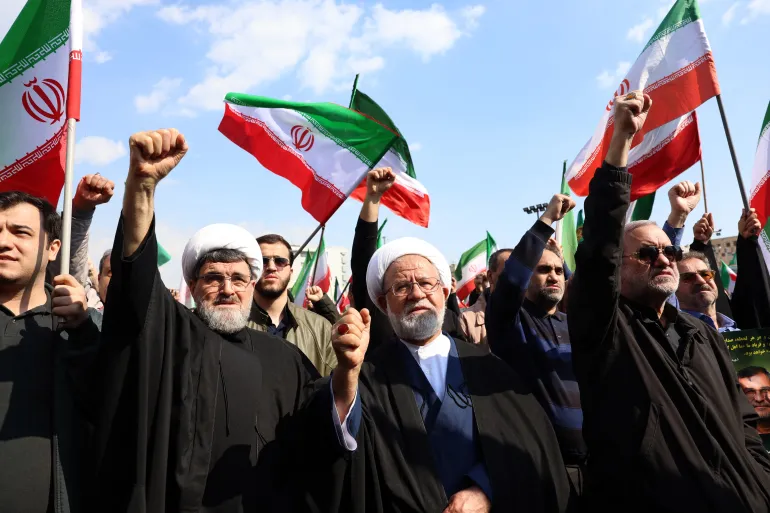
On April 1, 2026, Iranian authorities and state supporters took to the streets to mark the anniversary of the 1979 referendum that established the Islamic Republic. Coming exactly 33 days after the start of the U.S.-Israeli kinetic campaign, the celebrations were framed not merely as a historical commemoration, but as a “victory rally” in anticipation of a successful defense against the ongoing invasion. Consequently, the Iranian leadership is utilizing the imagery of the 1979 Revolution to bridge the gap between the revolutionary past and the embattled present. This suggests that despite the heavy damage to the country’s industrial and nuclear infrastructure, the state is successfully leveraging “siege mentality” to consolidate its core support base and project an image of internal cohesion to the world.
Origins and the “Second Revolution” Narrative
Originally, April 1 (Islamic Republic Day) was a celebratory milestone of the transition from monarchy to theocracy. However, the origin of the 2026 fervor lies in a new state narrative that characterizes the current war as the “Second Revolution”—a final struggle to purge Western influence from the region once and for all. As the U.S. and Israel continue to target symbolic sites and economic lifelines, the Iranian government has doubled down on the rhetoric of “Martyrdom and Resistance.” Furthermore, the report emphasizes that by linking the current war to the foundational struggle of 1979, the authorities are attempting to delegitimize domestic dissent, framing any opposition to the war effort as a betrayal of the 1979 “will of the people.”
Structure of the “Victory” Proclamation and Social Control
The structure of the 2026 anniversary is organized around a dual strategy of public spectacle and tightened social control. Specifically, state media broadcast images of large crowds in Azadi Square, where officials showcased the wreckage of downed Israeli drones alongside domestically produced missiles. Moreover, the article highlights the “strategic optimism” of the IRGC command, which has publicly stated that the coalition’s failure to achieve a “quick surrender” constitutes a strategic victory for Tehran. This structured optimism is essential for maintaining the morale of the security apparatus and the Basij units, who are currently tasked with both frontline defense and the suppression of any anti-war “rioters” in the major cities.
Synthesis of Ideological Survival and the Paradox of Legitimacy
The successful maintenance of the Islamic Republic’s authority now faces a paradox where the very war intended to “decapitate” the regime has provided it with a renewed ideological purpose. This objective is essential to understand because it illustrates how external aggression can inadvertently silence internal critics, as the “external enemy” becomes the primary focus of national energy. Simultaneously, there is a clear intent among the leadership to use this “war victory” narrative to justify the permanent exit from international treaties (like the NPT) as a form of “Revolutionary Independence.” Ultimately, the April 1 Al Jazeera report provides a stable warning: as long as the Iranian state can successfully conflate its survival with the spirit of 1979, the “Maximum Pressure” campaign may result in a more radicalized and entrenched regime rather than a democratic collapse.
Reference
Al Jazeera. (2026, April 1). Iran authorities await war ‘victory’ as supporters mark 1979 anniversary. Al Jazeera News. https://www.aljazeera.com/news/2026/4/1/iran-authorities-await-war-victory-as-supporters-mark-1979-anniversary