
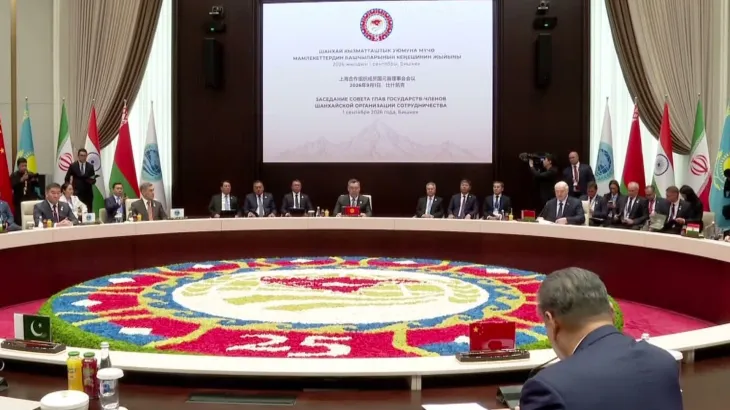
Kyrgyzstan’s decision to host the Shanghai Cooperation Organisation (SCO) summit represents an important moment for Central Asia. It also reflects changes in the international system. Global geopolitical tensions continue to reshape relations among major powers. Against this background, the summit brought together influential leaders from countries such as China, Russia, India, Iran, and Pakistan.
The presence of these countries demonstrates the growing importance of the SCO. The organization provides a forum for states that want to pursue their interests in an increasingly multipolar world.
According to Al Jazeera (2026), the summit reflects a broader transformation in international politics. The participating countries do not always share the same interests or political positions. However, many of them seek greater strategic autonomy. They also want to avoid depending exclusively on a Western-led international framework.
In this context, the SCO has become an important platform for dialogue. It brings together states involved in some of the world’s most important geopolitical disputes.
Kyrgyzstan Between Major Powers
For Kyrgyzstan, hosting the summit highlighted both the challenges and opportunities created by its geographic position. The country is located between Russia and China. Therefore, it must carefully manage its relationships with these powerful neighbors.
At the same time, Kyrgyzstan seeks to maintain ties with Europe and the United States. This approach reflects the multi-vector foreign policy followed by many Central Asian states since the collapse of the Soviet Union.
Kyrgyzstan’s strategy is also important because of its economic vulnerabilities. The country is landlocked and mountainous. As a result, it depends heavily on transportation corridors, foreign markets, and external energy sources.
For this reason, maintaining several international partnerships is not simply a diplomatic choice. It is also an economic necessity. Kyrgyzstan must avoid excessive dependence on a single power. At the same time, it can benefit from its strategic geographic position.
The SCO and the Rise of Multipolarity
The summit also illustrates the growing debate about a multipolar international order. Russia and China increasingly view organizations such as the SCO as important alternatives to institutions traditionally influenced by Western powers.
However, it would be misleading to describe the SCO as simply an anti-Western alliance. Its members have different strategic interests. In some cases, they also have serious disagreements.
India, China, Pakistan, Russia, and Iran do not share the same political priorities. Instead, the organization allows these countries to cooperate in specific areas. At the same time, they can continue to compete in others.
This complexity is one of the main characteristics of the SCO. It may also explain why the organization has become more relevant in contemporary international relations.
Central Asia’s Growing Strategic Importance
Another important aspect of the summit is the changing role of Central Asia in global politics. For decades, the region was often viewed mainly as an area between larger powers. Today, however, its strategic importance is increasing.
Several factors have contributed to this change. These include new trade routes, international sanctions, the war in Ukraine, and increased Chinese investment. Together, these developments have placed Central Asia in a more important position within global politics and trade.
Kyrgyzstan’s recent economic growth shows both the opportunities and risks created by these changes. Increased trade and investment have supported economic activity and infrastructure development. They have also contributed to higher wages.
However, part of this growth depends on external conditions. These conditions may not continue in the long term. Therefore, Kyrgyzstan faces an important challenge. It must transform temporary geopolitical opportunities into sustainable economic development.
A Region at the Center of Global Change
Overall, the SCO summit in Kyrgyzstan demonstrates the growing importance of Central Asia in a changing international order. Kyrgyzstan’s ability to maintain relationships with different powers will be important for its future.
The summit also shows that multipolarity does not necessarily create clear or unified blocs. Instead, the emerging international order is characterized by flexible partnerships and competing interests.
Countries are increasingly trying to maintain room for strategic maneuver. For Kyrgyzstan and other Central Asian states, keeping multiple diplomatic and economic options open may be an effective way to navigate an increasingly complex geopolitical environment.
Reference
Al Jazeera. (2026, September 3). Kyrgyzstan hosts pivotal SCO summit amid global geopolitical shifts. Al Jazeera.