
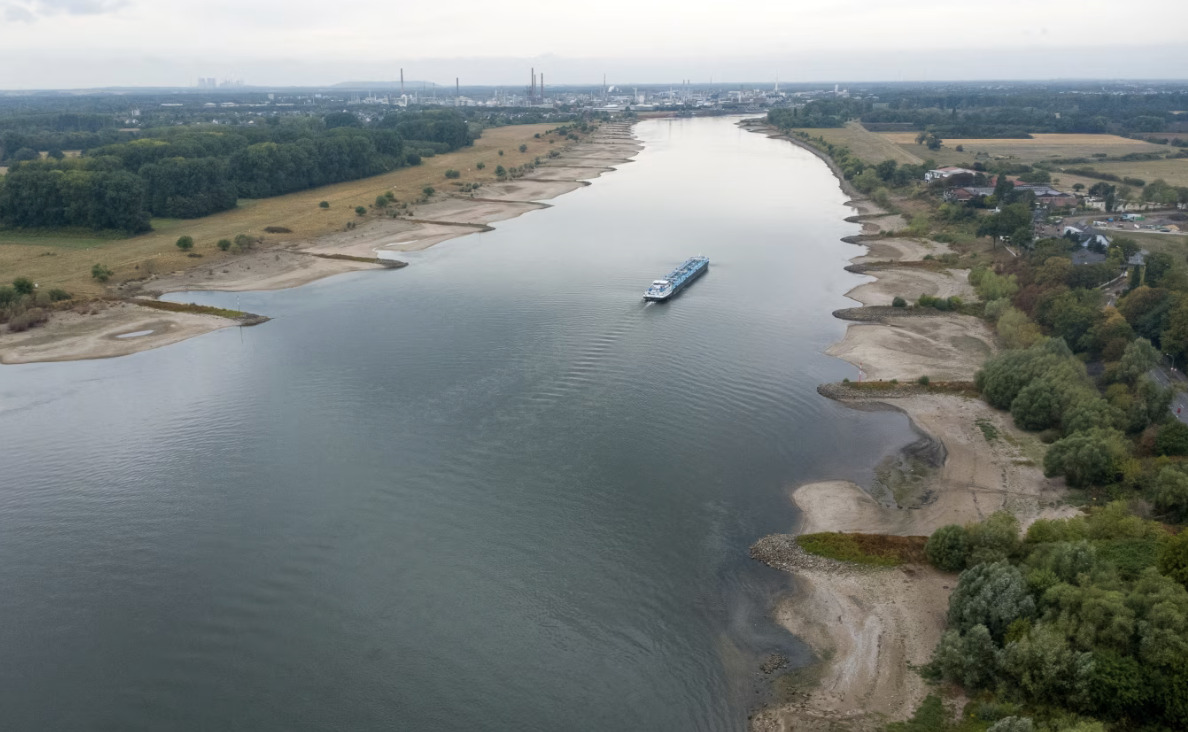
Rhine Shipping Disruptions
Low water levels caused by recent heatwaves are expected to slow Germany’s economic growth in the third quarter of 2026. According to the Bundesbank, limited transport routes on major rivers and rapidly increasing shipping costs will restrict industrial production and export growth. Conditions have become especially difficult at Kaub, a key bottleneck on the Rhine, where the water gauge recently reached a record low. As a result, ships must carry smaller loads to pass through the area, limiting the amount of goods that can be transported.
Recent heatwaves affected much of Western Europe during its hottest June and July on record. In Germany, shallow rivers are creating additional delivery delays and worsening existing material shortages. Moreover, higher transport expenses and slower shipments could postpone production. These disruptions are placing marked pressure on industrial activity just as the sector had begun to strengthen, making the transport problems an additional obstacle for factories and exporters.
A Weaker Third-Quarter Outlook
Germany’s economy proved more resilient than expected to the rise in energy prices caused by the war in Iran during the first half of 2026. Nevertheless, the Bundesbank expects activity to expand only marginally, at best, during the third quarter. Gross domestic product grew by 0.4% in the first quarter and 0.2% in the second after the economy recorded only subdued growth last year. Strong foreign demand for German goods provided most of the recent support.
However, that export strength may not continue in the months ahead. Some economists believe foreign companies temporarily increased their purchases of German products before expected cost increases and supply problems related to the conflict in the Middle East. If this stockpiling ends, export demand could weaken while transportation problems on the Rhine create further pressure on industrial production.
Investment, Inflation and Recovery
Several other conditions are limiting Germany’s growth. Low capacity utilization in the industrial sector and the European Central Bank’s interest-rate increase in June are reducing corporate investment. At the same time, high energy prices continue to weaken private consumption. Inflation could also rise temporarily in the coming months, although the Bundesbank found no evidence that the war is producing second-round inflationary effects through higher wages.
Despite these difficulties, the central bank still considers the German economy to be clearly on a recovery path. Robust recent manufacturing orders provide support for future activity. In addition, the government has pledged greater investment in defense and infrastructure. These factors should continue to support the economy even as shallow rivers, expensive energy, higher interest rates and possible export weakness limit growth in the near term.
Reference
Frankl, E. (2026, August 20). Low Rhine water levels to slow German economy, Bundesbank says. The Wall Street Journal. https://www.wsj.com/pro/central-banking/low-rhine-water-levels-to-slow-german-economy-bundesbank-says-e0571f55?st=wHheHF