
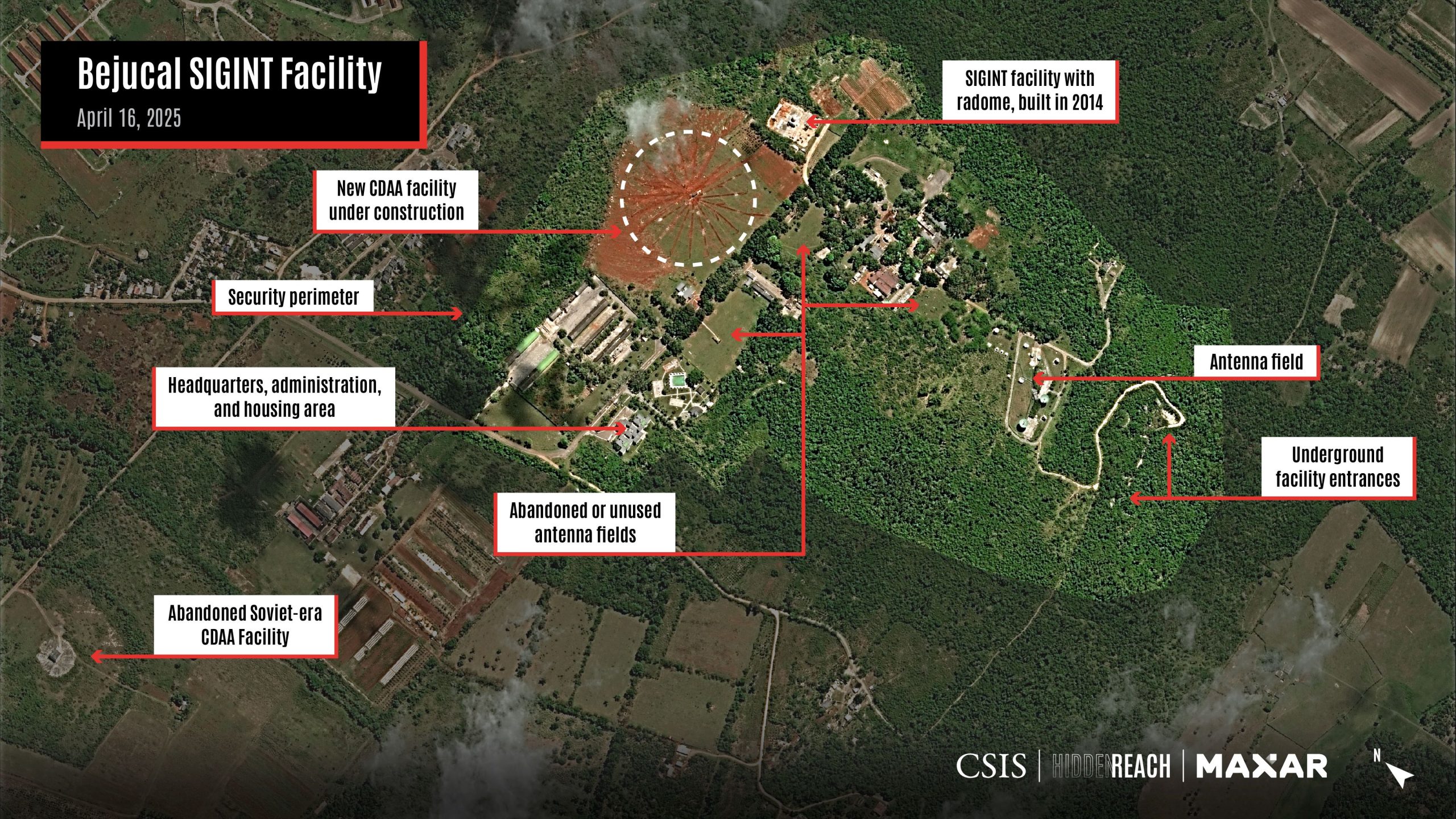
Recent satellite imagery and open-source data tracking the expansion of suspected Chinese signals intelligence (SIGINT) infrastructure across Cuba. Given its geographical position less than 100 miles south of Florida, Cuba represents a premier strategic vantage point. To track electronic signatures, map U.S. military maneuvers, and monitor space launches along the American southeastern seaboard. This foreign footprint has grown as China acts as a vital financial lifeline to a Cuban government. Which is struggling through its worst economic crisis since the fall of the Soviet Union.
The report focuses heavily on Bejucal, Cuba’s largest active SIGINT site and a former Soviet repository during the 1962 missile crisis. Recent imagery reveals substantial new excavation and the removal of older pole antennas on the northern side of the complex. In their place, construction is underway on a significantly larger, 175-meter-wide Circularly Disposed Antenna Array (CDAA). This massive 19-antenna array drastically expands high-frequency direction-finding capabilities. Allowing operators to locate and track air and maritime signals from thousands of miles away with vastly improved precision. While Bejucal represents a qualitative leap in surveillance technology, other suspected sites tell a mixed story. In addition, satellite data reveals that construction has abruptly stalled at another primary SIGINT facility. Raising questions about the fluctuating scope, financing, or diplomatic direction of the joint electronic espionage efforts.
In conclusion, the newly detected construction at Bejucal confirms a continuous, high-tech modernization of electronic surveillance. This capabilities positioned directly at the U.S. doorstep. Although unclassified satellite data lacks a direct “smoking gun” tying Beijing to everyday operations. The expanding scale of these long-range antenna systems strongly underscores a strategic ambition to exploit Cuba’s proximity. Ultimately, this evolving infrastructure guarantees that the Caribbean will remain an active, high-stakes electronic battleground. Fueling calls for a more aggressive U.S. security posture toward foreign intelligence networks operating in its backyard.
Reference
Funaiole, M. P., Hart, B., Bermudez, J. S., & Aidan Powers-Riggs. (2026). New Activity at Possible Chinese Intelligence Facilities in Cuba. Csis.Org. https://www.csis.org/analysis/new-activity-possible-chinese-intelligence-facilities-cuba