
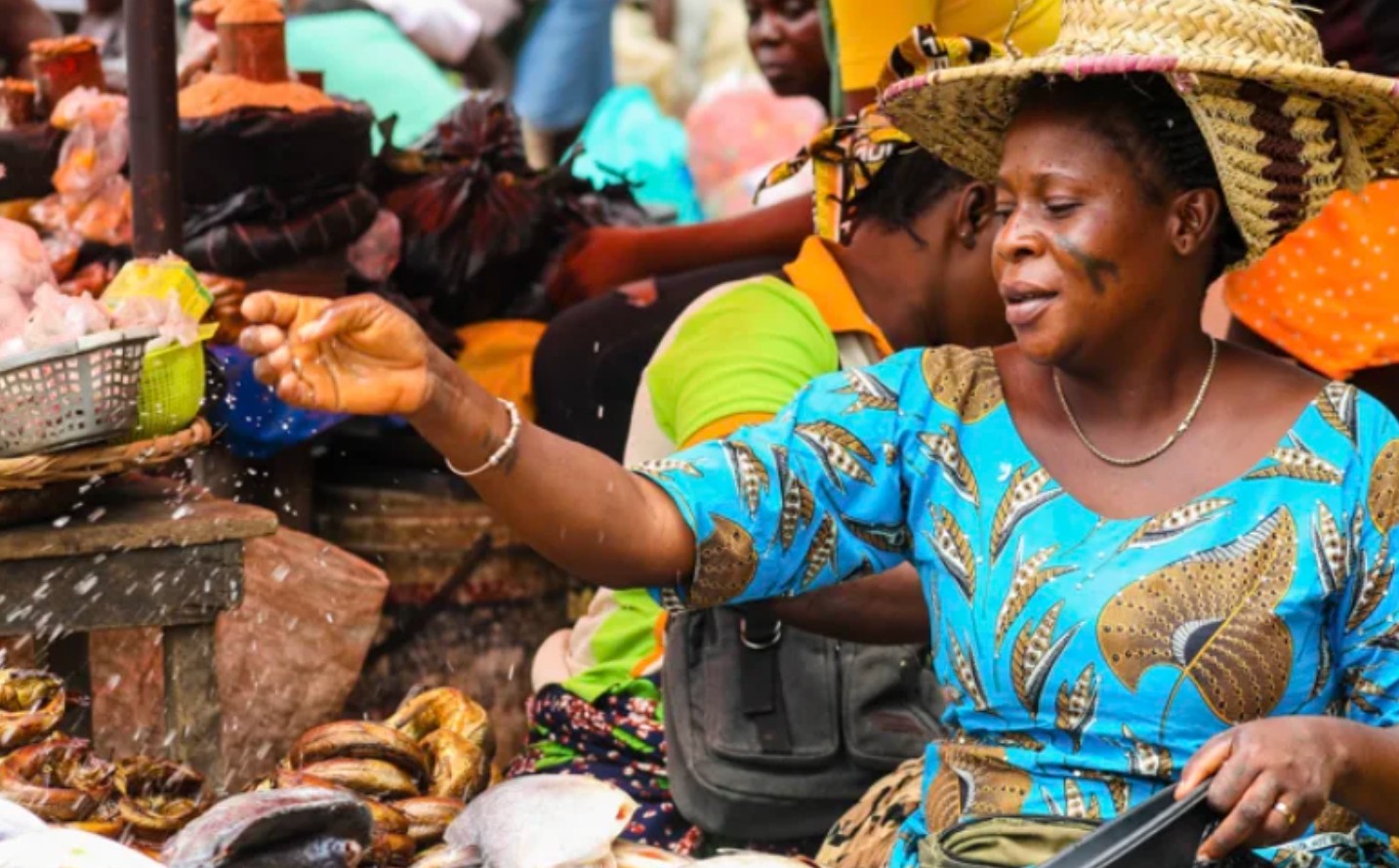
Women at the Heart of West Africa’s Regional Food Trade: What Women Food Traders Say about the Constraints and Opportunities They Face
Women’s Dominance This digital story, published by the Sahel and West Africa Club (SWAC) at the OECD, examines the role of women in West Africa’s regional food trade. It draws on a large-scale survey of 3,200 traders across 81 food markets in eight countries. For the first time at this scale, the publication captures women traders’ own perspectives on barriers and opportunities. The midstream food sector now generates 40% of agrifood value added. It also accounts for around one-quarter of West Africa’s food economy jobs, making women’s economic role increasingly central to regional food security.
Women’s Dominance — and Structural Concentration
Women are the driving force behind the “hidden middle” that connects farms to cities and crosses borders. They account for 88% of jobs in food-away-from-home services, 83% in food processing, and 71% in food marketing. However, the survey reveals clear gender-based gaps in how this participation is structured. Men dominate livestock (one of the most profitable value chains) while women concentrate in cereals, spices, fish, and processed foods. These are essential sectors, yet often less profitable. As a result, women traders report a median monthly turnover of USD 8,140, which is 57% lower than the USD 19,023 reported by men. Women-led businesses also employ fewer people on average: 4.3 employees, compared to 6.2 for men-led businesses.
Informality is pervasive across genders. In fact, 83% of traders are not formally registered and 83% do not hold an import or export certificate.
What Women Traders Say They Need
Women traders identified access to finance as the second most significant barrier to growth, just after trade restrictions and taxes. Therefore, financial inclusion emerges as a clear policy priority. Other challenges include border procedures, security issues, poor transport infrastructure, and limited market information. When asked what governments should prioritize, women pointed to three areas: improving access to finance and support (25%), streamlining border procedures (21%), and upgrading road infrastructure and safety (11%).
In addition, a social network analysis of the rice sector in the Dendi area (spanning Benin, Niger, and Nigeria) helps explain why women remain in lower-value positions. Men tend to occupy the most strategic and lucrative nodes within commercial networks. Women, by contrast, are often relegated to the periphery. They have fewer connections to key actors and limited access to decision-making spaces. These gaps are rooted in social norms, restricted mobility, and unequal access to land, finance, and information.
Resilience and Optimism Despite the Barriers
Despite persistent constraints, over 40% of women traders reported an improvement in their business over the past five years. Moreover, 20% said their situation has remained stable. Looking ahead, 62% expressed optimism about growth over the next five years. Consequently, while structural barriers remain significant, these findings point to a resilient and growing sector, one that could thrive further with targeted action on finance, regulation, and infrastructure.
Reference
OECD – Sahel and West Africa Club (SWAC). (2026). Women at the heart of West Africa’s regional food trade: What women food traders say about the constraints and opportunities they face. OECD. https://oecd-swac.shorthandstories.com/women-at-the-heart-of-west-africas-regional-food-trade/