
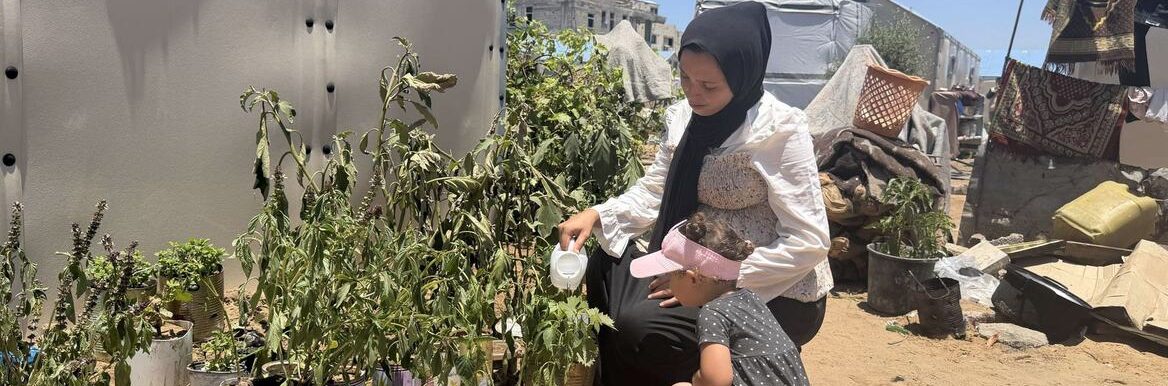
Temporary housing offers displaced families a new beginning.
After being displaced countless times since the outbreak of the Israel-Hamas war in October 2023, 24-year-old Mayyada and her family have finally moved into a temporary housing unit provided through the UN Development Programme (UNDP). Pregnant with twins and caring for her two-year-old daughter, she described years of moving between schools, shelters, and makeshift tents while facing overcrowding, insecurity, and the loss of privacy. The new shelter provides a safer and more dignified living space, allowing the family to begin rebuilding their daily lives.
UNDP expands neighborhood recovery across Gaza.
The temporary housing units are part of the Gaza Neighbourhood Approach project, implemented by UNDP in coordination with the Palestinian Authority, UN agencies, and other partners. Beyond providing shelter, the initiative includes debris removal, rehabilitation of essential services, emergency employment opportunities, and restoration of basic infrastructure. These activities are supported through UNDP’s REVIVE (Relief, Employment and Vital Infrastructure for the Vulnerable in Emergencies) programme, which operates across six countries to strengthen community recovery after crises.
War has transformed livelihoods and family life.
Before the conflict, Mayyada worked as a portrait artist, selling her paintings and building a future with her husband. The war forced the family to abandon not only their home but also their careers, routines, and long-term plans. Repeated displacement meant starting over with limited resources, often sharing overcrowded tents with relatives or strangers before constructing a fragile shelter from wood, fabric, and plastic sheets. The temporary housing unit has restored privacy and stability, but the family still hopes to return to a permanent home.
International support remains essential for long-term recovery.
UNDP’s recovery strategy combines temporary housing with the rehabilitation of water wells, health centres, waste management systems, and educational services. The programme is supported by funding from Germany, the Republic of Korea, and Sweden, while additional efforts focus on repairing partially damaged homes. Despite these advances, the organization stresses that humanitarian needs remain enormous due to widespread infrastructure destruction across Gaza. Transitional shelters represent only an intermediate solution as long-term reconstruction and community recovery continue.
Reference
United Nations. (2026, July 12). Reviving communities home by home in Gaza. UN News. https://news.un.org/en/story/2026/07/1167921