
Extreme rainfall triggers deaths and evacuations
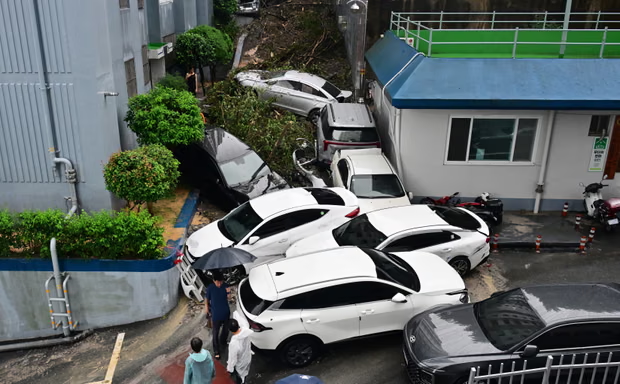
South Korea and the Philippines are experiencing severe flooding and landslides caused by exceptionally heavy monsoon rains. In South Korea, the southern province of South Gyeongsang has been particularly affected, with some areas receiving hundreds of millimeters of rain in only a few days. The extreme precipitation has triggered landslides, damaged infrastructure and forced hundreds of residents to evacuate.
In the city of Geoje, more than 800 millimeters of rain were recorded over several days, while neighboring Tongyeong also experienced exceptionally high rainfall. A landslide struck an apartment building in Geoje, killing one person and injuring four others. Authorities have described the rainfall as unusually intense, with some locations receiving what would normally represent a large portion of their seasonal precipitation within only a few days.
South Korea mobilizes emergency services
The heavy rainfall has caused widespread disruption in South Korea. Hundreds of residents have been evacuated from vulnerable areas, while flooding has affected homes, schools and public infrastructure. Power outages have also been reported, placing additional pressure on emergency services.
South Korean authorities have instructed police, firefighters and other emergency agencies to prioritize rescue operations and assistance to affected communities. The scale of the rainfall has also raised concerns about additional landslides and flooding as saturated soil becomes increasingly unstable.
The disaster highlights the vulnerability of densely populated areas to increasingly intense precipitation and demonstrates the importance of effective early-warning systems, drainage infrastructure and emergency planning.
Major flooding affects the Philippines
The Philippines is experiencing a similarly serious situation. Persistent monsoon rains have caused widespread flooding in northern Luzon and the Manila metropolitan area, disrupting transportation, schools and government operations.
According to Philippine authorities, millions of people have been affected by the flooding, while thousands have been forced to seek shelter in emergency evacuation centers. Deaths have been reported as a result of flooding and landslides.
One of the most serious incidents occurred in Baguio, a mountainous city in northern Luzon, where a landslide buried homes and killed several people. The incident demonstrates the particular risks faced by mountainous communities, where prolonged rainfall can saturate hillsides and trigger sudden landslides.
A regional challenge for Asia-Pacific
The simultaneous disasters in South Korea and the Philippines illustrate the broader challenges posed by extreme weather across the Asia-Pacific region. Although the two countries differ significantly in geography, infrastructure and economic development, both face growing risks associated with intense rainfall, flooding and landslides.
Extreme weather can have consequences beyond immediate humanitarian losses. Flooding can interrupt transportation networks, damage infrastructure, affect agricultural production and disrupt local and regional supply chains. For highly interconnected Asian economies, these disruptions can generate economic consequences that extend beyond the areas directly affected.
Climate resilience and disaster preparedness
The events also underline the importance of climate resilience and disaster preparedness. Governments in the region face increasing pressure to strengthen early-warning systems, improve urban drainage, reinforce infrastructure and develop more effective evacuation mechanisms.
For countries such as the Philippines, which are particularly exposed to typhoons and extreme rainfall, disaster preparedness is closely linked to economic and social resilience. South Korea’s experience similarly demonstrates that even countries with advanced infrastructure can face serious challenges when rainfall reaches unprecedented levels over a short period.
International relevance
The events are internationally relevant because they demonstrate how extreme weather is becoming an increasingly important policy and economic challenge in Asia-Pacific. Both South Korea and the Philippines are important economies in the region, and disruptions caused by natural disasters can affect transportation, production, agriculture and supply chains.
The situation is also relevant to discussions about climate adaptation and international cooperation. As extreme weather events become more disruptive, governments increasingly need to share information, improve early-warning systems and develop regional strategies for disaster risk reduction.
For the Observatorio Global UDLAP (OGU), the article provides an opportunity to examine the relationship between climate change, disaster management, public policy and economic resilience in Asia-Pacific. It also demonstrates that environmental risks can quickly become humanitarian, political and economic challenges requiring coordinated responses.
The Guardian. (2026, August 18). South Korea city deluged by almost a metre of rain, triggering deadly landslide. The Guardian. https://www.theguardian.com/world/2026/aug/18/south-korea-rain-deadly-landslide-philippines-major-flooding?