
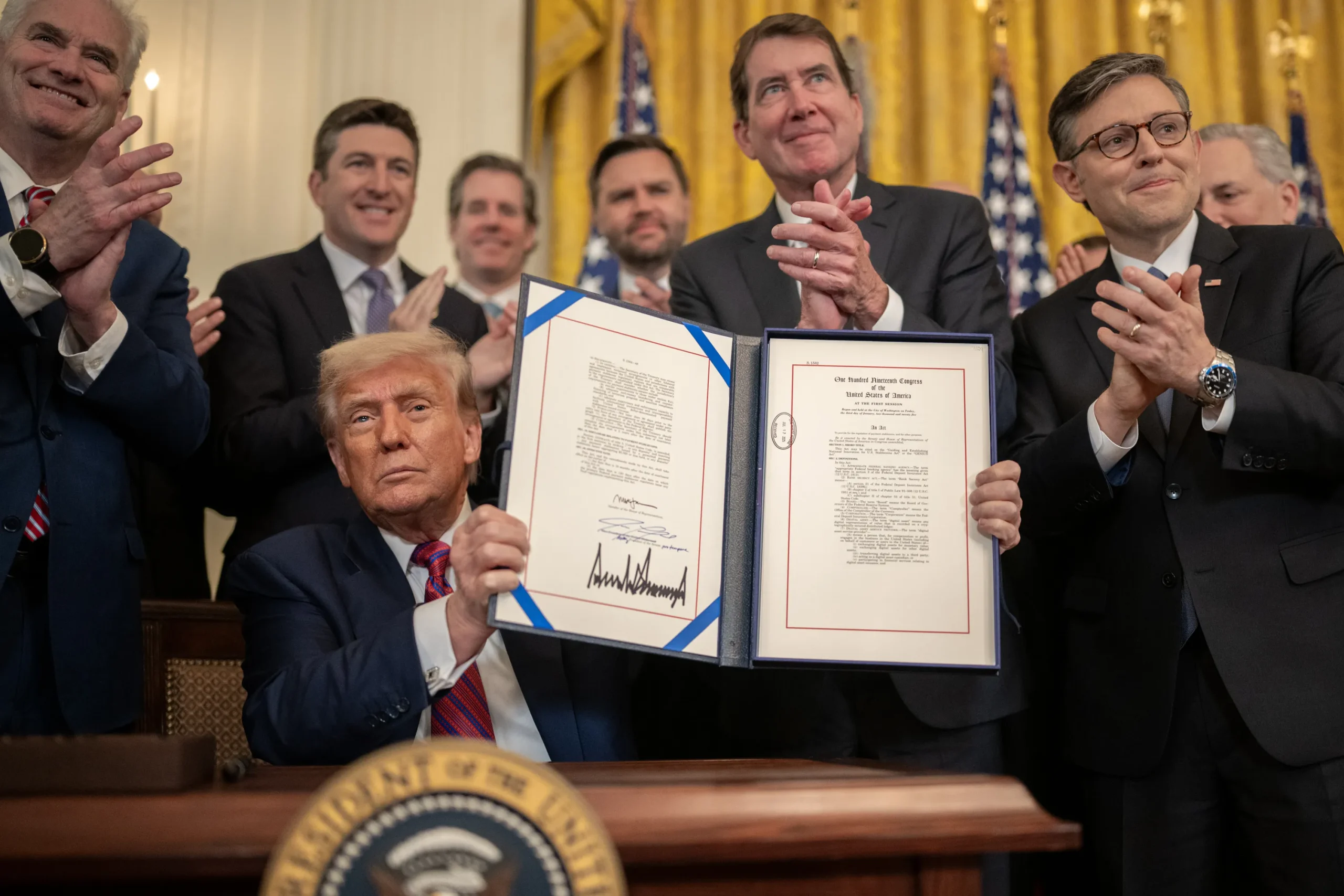
The rapid expansion of dollar-backed stablecoins has moved them from the margins of cryptocurrency markets into broader debates about payments, financial stability, and the international role of the U.S. dollar. In their Brookings analysis, Nellie Liang and Brent Neiman examine how stablecoins could reshape the financial system following the adoption of the GENIUS Act in 2025.
The authors argue that properly regulated stablecoins could make payments faster and more efficient while reinforcing the dollar’s global position. However, their expansion could also create risks for financial stability, consumer protection, bank lending, sanctions enforcement, and federal debt management.
Stablecoins and the Future of Payments
Stablecoins are privately issued digital assets designed to maintain a stable value, with most tied to the U.S. dollar. Unlike traditional cryptocurrencies such as Bitcoin, they aim to function as a form of digital money that can circulate through blockchain networks.
The authors highlight their potential to improve payment systems, particularly for international transactions. Stablecoins can settle transactions almost instantly and operate continuously, while smart contracts could automate processes that currently depend on banks and other intermediaries.
The market had reached approximately $270 billion by June 2026. The GENIUS Act establishes federal rules for payment stablecoins and requires issuers to maintain reserves at least equal to the value of the stablecoins they issue.
The Dollar and U.S. Financial Power
Beyond payment efficiency, Liang and Neiman argue that stablecoins could strengthen the international role of the dollar. Wider access to digital dollars could expand the use of dollar-denominated assets in countries with high inflation or weaker financial systems.
At the same time, this expansion could create tensions with other governments. Foreign authorities may view widespread use of dollar-backed stablecoins as a threat to monetary sovereignty, particularly if residents increasingly use digital dollars instead of domestic currencies.
The authors therefore emphasize the need for U.S. policymakers to consider the international consequences of stablecoin growth. Maintaining the dollar’s global position may require greater coordination with foreign governments as digital payment systems continue to develop.
Financial and National Security Risks
The benefits of stablecoins depend heavily on effective regulation. The authors argue that issuers need sufficient capital and liquidity to guarantee redemption at any time. They also point to gaps in consumer protection, including fraud recovery, dispute resolution, and settlement safeguards.
National security presents another challenge. The United States currently relies on traditional banking networks to enforce sanctions and combat money laundering. If stablecoins reduce dependence on those networks, U.S. authorities could lose part of that financial leverage.
For this reason, Liang and Neiman recommend strong compliance requirements for stablecoin issuers and wallet providers. These systems should allow authoriti
Implications for U.S. Debt and Banks
Stablecoins could also affect the U.S. Treasury market. Because the GENIUS Act requires reserves to rely heavily on short-term Treasury securities, significant growth in stablecoins could increase demand for Treasury bills.
The authors estimate that different adoption scenarios could generate between $400 billion and $2.3 trillion in additional demand for Treasury bills by 2030. However, the fiscal benefits would depend on where the growth comes from and whether stablecoins replace other investors rather than creating new demand.
There are also potential costs. Greater reliance on short-term Treasury securities could increase refinancing needs, while the movement of deposits from commercial banks to stablecoins could reduce an important source of credit, particularly for small businesses.
The analysis presents stablecoins as a financial innovation with significant potential but equally important tradeoffs. They could improve payment systems, support the international role of the dollar, and increase demand for U.S. Treasury securities.
However, these benefits are not automatic. Regulators must address financial stability, consumer protection, illicit finance, bank intermediation, and debt management as the GENIUS Act takes effect.
The central question is therefore not whether stablecoins will expand, but whether policymakers can establish a regulatory framework that captures their benefits
Reference
Liang, N., & Neiman, B. (2026, August 19). Stablecoins after GENIUS: Private money, public debt, and the global dollar. Brookings Institution. https://www.brookings.edu/articles/stablecoins-after-genius/