
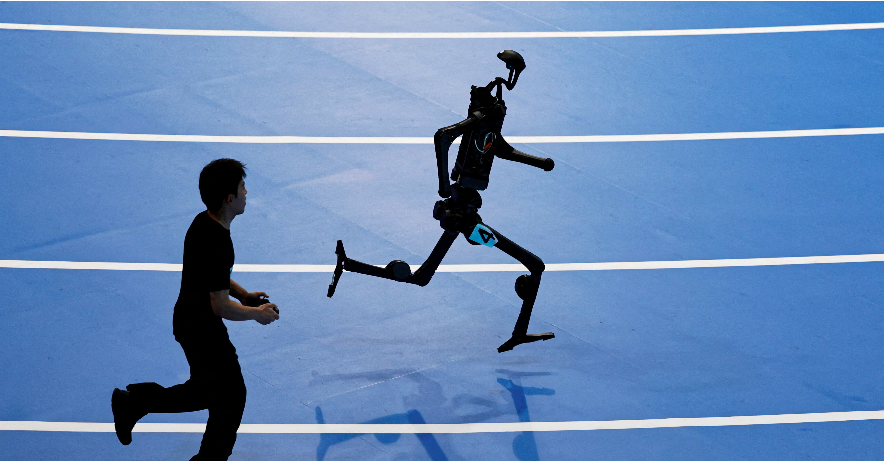
Over the past decade, autonomous robotics has shifted from experimental prototypes to large-scale deployment in sectors such as manufacturing, logistics, ports and healthcare, enabled by breakthroughs in computing power, simulation, and AI models for perception and action. A thousand-fold acceleration in compute, the use of digital twins and synthetic data to narrow the “simulation to reality gap”, and Vision-Language-Action models now allow robots to train virtually and then execute complex tasks in the physical world, while cheaper, more capable hardware has lowered development costs and expanded adoption. In highly structured settings like ports and warehouses, fleets of robots already operate continuously, and some experts forecast that by 2050 around 70% of global manufacturing operations could be largely autonomous.
However, bringing robots into homes requires systems that can handle unstructured environments full of unpredictable variables, such as children, pets, and clutter, along with better abilities in risk assessment, anomaly detection and human-like judgement. Experts compare advanced robots to powerful tools that demand clear rules and boundaries, arguing that safety and cost remain major barriers, since domestic robots capable of chores like dishwashing or folding clothes still carry prohibitive price tags. Progress is focusing on object manipulation, described as a “holy grail” because tasks humans find trivial (such as picking up a cup of water while adjusting grip, estimating weight and detecting slip) are extremely hard to encode in machines, especially given current limitations in tactile sensing.
For now, human intuition continues to complement AI via teleoperation, with remote operators intervening when processes fail or environments become too complex or dangerous. Robotics is evolving along a hierarchy from rule-based automation to training-based systems and then to context-based intelligence that integrates language and vision so robots can understand why they act, not only how. According to this perspective, “the hardest advances in robotics are behind us,” and the coming era will emphasize deployment in unstructured environments, improved manipulation and contextual reasoning, and responsible collaboration between humans and autonomous systems.
Reference
Crowfoot, T. (2026, March 18). “The hardest advances in robotics are behind us”: What comes next? World Economic Forum. https://www.weforum.org/stories/2026/03/advances-in-autonomous-robotics-what-comes-next/