
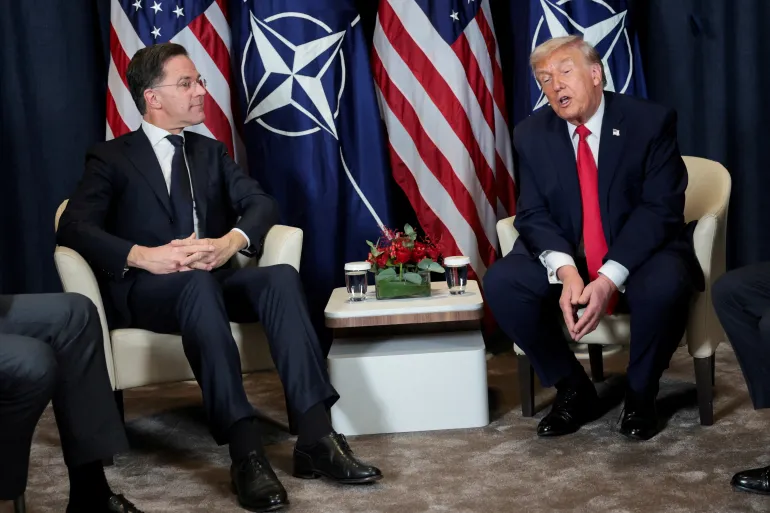
The Transition from Collective Defense to “Transactional Security”
By April 2026, the U.S. administration has transitioned from traditional leadership within the North Atlantic Treaty Organization (NATO) to a posture of active skepticism. The report highlights that high-level officials are “mulling” a formal withdrawal from the alliance once the Iran war reaches a conclusion. Consequently, the principle of Article 5—the “all for one” collective defense clause—is being treated as a negotiable liability rather than a sacred vow. This suggests that the administration views European security concerns as a distraction from the primary U.S. objectives in the Middle East and the Indo-Pacific.
Origins and the “European Burden” Narrative
Originally, NATO was the bedrock of Western containment policy. However, the origin of this 2026 withdrawal threat lies in the Institutional Friction (Article #94) generated during the Iran conflict. The administration has expressed frustration that European allies did not provide sufficient military or logistical support for the “Maximum Pressure” campaign and the Strait of Hormuz blockade. For 2026, the White House is framing NATO as an “obsolete” entity that allows Europe to “free-ride” on American taxpayers while obstructing U.S. strategic interests abroad. Furthermore, the report emphasizes that the April 7 Bombing Suspension (Article #92) has emboldened the administration to demand a “New Security Deal” with Europe on strictly transactional terms.
The Structure of a Potential U.S. Exit
The structure of a potential withdrawal is organized around three strategic phases:
- Financial Decoupling: A further reduction of U.S. contributions to NATO’s common-funded budgets to force European states to meet the 2% GDP spending target immediately.
- Bilateralism Over Multilateralism: Shifting focus from NATO-wide agreements to specific bilateral defense pacts with “reliable” allies like Poland or the UK.
- Command Restructuring: The potential withdrawal of the Supreme Allied Commander Europe (SACEUR), a position traditionally held by a U.S. officer. Moreover, the article highlights the “Strategic Panic” in Brussels, where EU leaders are scrambling to accelerate the “European Defense Union” to compensate for a potential loss of the American nuclear umbrella.
Synthesis of the “End of the West” and the New Bipolarity
The successful threat of a NATO withdrawal now faces a paradox: by threatening to leave, the U.S. may destroy the very Global Hegemony it seeks to preserve. This represents a fundamental shift in Political Science theory from “Hegemonic Stability” to “Hegemonic Retreat.” There is a clear intent among U.S. hardliners to signal that the “Liberal International Order” is dead, replaced by a world of Sovereign Spheres of Influence. Ultimately, it is clear that the Iran war has served as the catalyst for the U.S. to break its oldest marriage; if the withdrawal moves from “mulling” to “manifesto,” the geopolitical map of the 21st century will be permanently redrawn, leaving Europe to defend its own borders for the first time since 1945.
Reference
Al Jazeera. (2026, April 8). Trump administration says it is mulling NATO withdrawal after Iran war. Al Jazeera News Europe. https://www.aljazeera.com/news/2026/4/8/trump-administration-says-it-is-mulling-nato-withdrawal-after-iran-war