
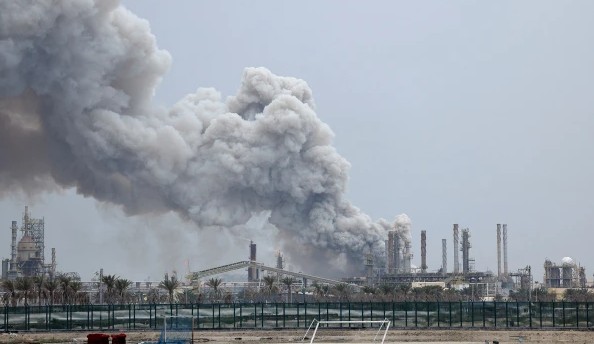
In the article “The New Era of Drone Warfare Takes Root in Iran,” published by the Council on Foreign Relations, Michael C. Horowitz and Lauren Kahn analyze how the ongoing conflict involving Iran, the United States, and Israel illustrates the emergence of a new military paradigm centered on precise mass warfare. Drawing lessons from the war in Ukraine and recent developments in the Middle East, the authors argue that the widespread use of low-cost, high-precision drones at scale is reshaping modern warfare. This transformation, driven by technological innovation and shifting military economics, suggests that drone-based systems will become a standard component of armed conflict, much like tanks or machine guns in earlier eras.
The Rise of Precise Mass Warfare
A central argument of the analysis is that contemporary warfare has entered an era of precise mass, characterized by the high-volume deployment of inexpensive but accurate weapon systems. The ongoing war in Ukraine provided the first large-scale demonstration of this phenomenon, but the current conflict involving Iran shows how these dynamics are spreading globally.
Operation Epic Fury, a U.S. campaign targeting Iranian infrastructure, demonstrated the operational deployment of the Low-Cost Unmanned Combat Attack System (LUCAS), a loitering munition inspired by Iran’s Shahed-136 drone. Developed in roughly eighteen months and deployed to U.S. Central Command in late 2025, LUCAS reflects the Pentagon’s growing recognition that future conflicts will require scalable, affordable systems capable of operating in large numbers.
This shift echoes historical technological turning points in warfare. Just as the Gulf War introduced widespread reliance on satellite and GPS capabilities, the Ukraine war and the conflict involving Iran are increasingly defined by artificial intelligence, cyber capabilities, commercial space assets, and especially drone systems.
Drones and the Changing Economics of Conflict
The conflict in the Middle East highlights a critical strategic challenge: the cost imbalance between offensive drones and defensive systems. Iranian Shahed-136 drones cost roughly $20,000 to $50,000 per unit, while the missile interceptors used to destroy them can cost millions. For example, a Patriot interceptor may cost around $4 million, while cheaper alternatives such as Coyote interceptors still cost more than $100,000 per shot.
This cost asymmetry places defenders on the wrong side of the economic equation. Even when air defense systems intercept up to 80 percent of incoming drones, the remaining percentage can still produce significant damage when attacks involve hundreds or thousands of systems.
Iran has leveraged this strategy extensively, launching large numbers of drones and ballistic missiles against Israeli targets, U.S. bases, and regional infrastructure. Although many drones are intercepted, their persistent use strains defensive resources and depletes interceptor stockpiles. In some cases, drone strikes have also caused direct casualties, including the deaths of several U.S. service members.
Another challenge lies in production capacity. While countries can manufacture thousands of drones relatively quickly using commercial components and autonomous guidance technologies, advanced defensive systems require longer development timelines and specialized supply chains. This disparity allows countries with fewer resources to maintain sustained pressure on technologically advanced adversaries.
Rethinking the Role of Drones in Warfare
Horowitz and Kahn emphasize that the term “drone” now encompasses a wide variety of military systems with very different functions. Treating them as a single category obscures important distinctions in how these technologies operate on the battlefield.
For example, high-altitude and medium-altitude long-endurance drones are often used for surveillance or precision strikes against targets lacking advanced air defenses. These systems can cost millions of dollars and are not easily replaceable.
In contrast, one-way attack drones, such as the Shahed-136, function more like artillery or cruise missiles. Designed to be expendable, these systems overwhelm defenses through sheer numbers rather than technological sophistication.
At the lower end of the spectrum are tactical reconnaissance drones, which provide short-range intelligence and situational awareness. Meanwhile, at the high end of military technology are collaborative combat aircraft, advanced autonomous systems designed to operate alongside fighter jets as “loyal wingmen.”
Understanding these distinctions is essential for evaluating how different types of drones contribute to military operations and how they interact with other battlefield systems.
Implications for Future Warfare
The spread of precise mass capabilities suggests that future wars will involve large numbers of inexpensive autonomous systems operating alongside traditional military platforms. Advances in artificial intelligence, commercial manufacturing, and guidance technologies make it possible to produce drones at unprecedented scale.
Russia, Ukraine, and Iran have already demonstrated this shift, producing tens of thousands of drones annually. Russia has even announced plans to manufacture up to one thousand Shahed-type drones per day. By comparison, advanced missiles in the U.S. arsenal can take years to scale up production.
This disparity indicates that the future of warfare may increasingly favor countries capable of rapidly producing large quantities of relatively simple systems. For the United States, the authors argue, adapting to this new reality will require greater investment in scalable and affordable military technologies.
Ultimately, the emergence of precise mass warfare represents a structural transformation in military strategy. As drone technology continues to evolve and spread, the large-scale deployment of low-cost autonomous systems is likely to become a permanent feature of global conflict.
Reference
Horowitz, M. C., & Kahn, L. (2026, March 9). The new era of drone warfare takes root in Iran. Council on Foreign Relations. https://www.cfr.org/articles/