
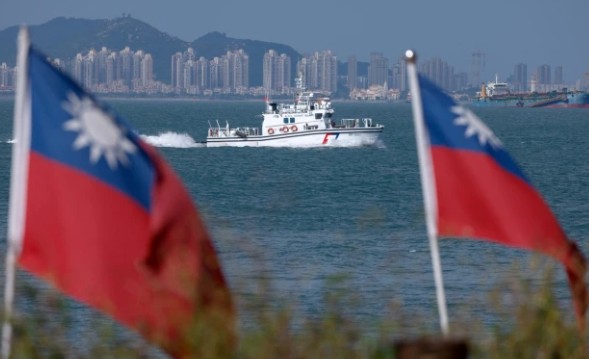
How to Prepare for New Dangers — A report by the Council on Foreign Relations
Why a Future Taiwan Crisis Could Be More Dangerous
The report The Next Taiwan Crisis Won’t Be Like the Last: How to Prepare for New Dangers argues that current strategic thinking about Taiwan is based on outdated assumptions. According to the authors, the geopolitical environment surrounding Taiwan has changed dramatically, increasing the likelihood that a future crisis could escalate rapidly and involve multiple regional and global actors.
Taiwan is described as the most dangerous flashpoint in the world today, as it combines several risk factors simultaneously: growing Chinese military power, rising tensions across the Taiwan Strait, and an increasingly unstable international system. China’s leadership has repeatedly emphasized that reunification with Taiwan is central to the “great rejuvenation of the Chinese nation,” and Chinese military modernization has expanded Beijing’s coercive options. At the same time, Taiwan’s democratic consolidation and the decline in support for unification have made a peaceful settlement less likely.
The report emphasizes that the risk of confrontation is not limited to a direct clash between China and Taiwan. Instead, the next Taiwan crisis could be triggered indirectly by conflicts elsewhere in the region, drawing the United States and its allies into a wider geopolitical confrontation.
Rethinking the Dynamics of a Taiwan Crisis
Traditional scenarios of a Taiwan crisis often assume a clear trigger: a Taiwanese declaration of independence followed by immediate Chinese military retaliation. However, the report argues that this narrow view ignores several alternative pathways to conflict.
China could pursue a wide range of coercive actions, including seizing Taiwan’s offshore islands, launching cyberattacks on critical infrastructure, disrupting maritime trade routes, or conducting missile strikes. More aggressive scenarios could include a complete blockade of Taiwan or a full-scale invasion.
Yet the report stresses that a future conflict may not originate directly from Taiwan or China. Regional disputes (particularly in the South China Sea, the East China Sea, or on the Korean Peninsula) could create chain reactions that eventually involve Taiwan. These interconnected flashpoints significantly increase the complexity of crisis management.
Another key factor is the possibility of simultaneous crises. Policymakers often assume that a Taiwan conflict would occur in isolation, allowing the United States and its allies to concentrate their resources on the region. In reality, global instability means that a Taiwan crisis could emerge while other conflicts are already underway, stretching military and political resources.
A Regional Conflict: The Expanding Role of Allies and Partners
Unlike previous cross-strait crises, which primarily involved China, Taiwan, and the United States, the next Taiwan crisis would likely involve multiple actors across the Indo-Pacific.
Japan and the Philippines are particularly central to this dynamic. Japan hosts major U.S. military bases that would be essential for any American defense of Taiwan, yet the United States requires Tokyo’s approval to use those bases for operations not directly related to Japan’s defense. Political hesitation in Japan could therefore complicate U.S. crisis management.
The Philippines represents another crucial strategic location. Its proximity to Taiwan and the presence of U.S. military access agreements mean that Philippine territory could become a key logistical hub during a crisis. However, Manila may face strong domestic and diplomatic pressures when deciding how far to support U.S. operations.
Other regional actors could also become involved. Australia’s participation through the AUKUS security framework could strengthen allied military capabilities, while South Korea might provide logistical support due to its close alliance with the United States. Meanwhile, China could seek assistance from partners such as Russia or North Korea in order to distract or divide U.S. allies.
The report therefore concludes that any conflict over Taiwan would likely spread far beyond the Taiwan Strait, transforming into a broader regional war.
Escalation Risks: From Regional War to Global Consequences
The authors warn that escalation in a Taiwan conflict could occur both geographically and technologically. Fighting would not be limited to conventional military operations around the island.
Cyberattacks could target critical infrastructure such as energy grids, communications networks, and financial systems. Space-based assets could also become targets as both sides attempt to disrupt satellite communications and surveillance capabilities.
Military strikes might extend to bases across the Indo-Pacific, including U.S. facilities in Japan and Guam. Because modern warfare relies heavily on interconnected systems, commanders may attempt early strikes against command-and-control infrastructure to gain an advantage.
The report also raises concerns about nuclear escalation. Although nuclear weapons are often assumed to be a last resort, China could potentially use nuclear threats to deter allies such as Japan from supporting the United States. The presence of multiple nuclear-armed actors increases the stakes and uncertainty of any conflict.
Policy Recommendations for Preventing a Taiwan Crisis
To reduce the risk of conflict, the report proposes several strategic policy recommendations.
First, the United States should pursue diplomatic measures aimed at reducing tensions before a crisis occurs. One proposal involves negotiating understandings with China about acceptable military activities near Taiwan, such as limiting large-scale military deployments and restoring operational boundaries like the median line in the Taiwan Strait.
Second, U.S. intelligence agencies should analyze a broader range of potential crisis triggers, including scenarios involving cooperation between China and other states such as Russia or North Korea.
Third, Washington should improve coordination with allies before a crisis begins. The report suggests establishing mechanisms for consultation among Indo-Pacific partners to share intelligence, coordinate responses, and develop common warning indicators of potential Chinese aggression.
Fourth, the United States should conduct more crisis simulations involving political leaders from allied countries. These exercises would help policymakers better understand alliance dynamics and political constraints during a real crisis.
Finally, the report recommends strengthening informal diplomatic channels, often called Track 2 or Track 1.5 dialogues, between the United States, Taiwan, and regional partners to prepare for potential contingencies.
Reference
Stares, P. B., & Sacks, D. (December, 2025). The next Taiwan crisis won’t be like the last: How to prepare for new dangers. Council on Foreign Relations.